
FROM THE EDITORIAL DESK
Editor’s note
A festive October: learning from practice, a growing community and a clear invitation to take part.
Dear members,
October arrived with the color, music and energy of Navratri, Durga Puja and Dussehra. Vijayadashami, on 20 October 2026, reminds us of that perseverance and right intent prevail, and it was a month of new beginnings for our Chapter too.
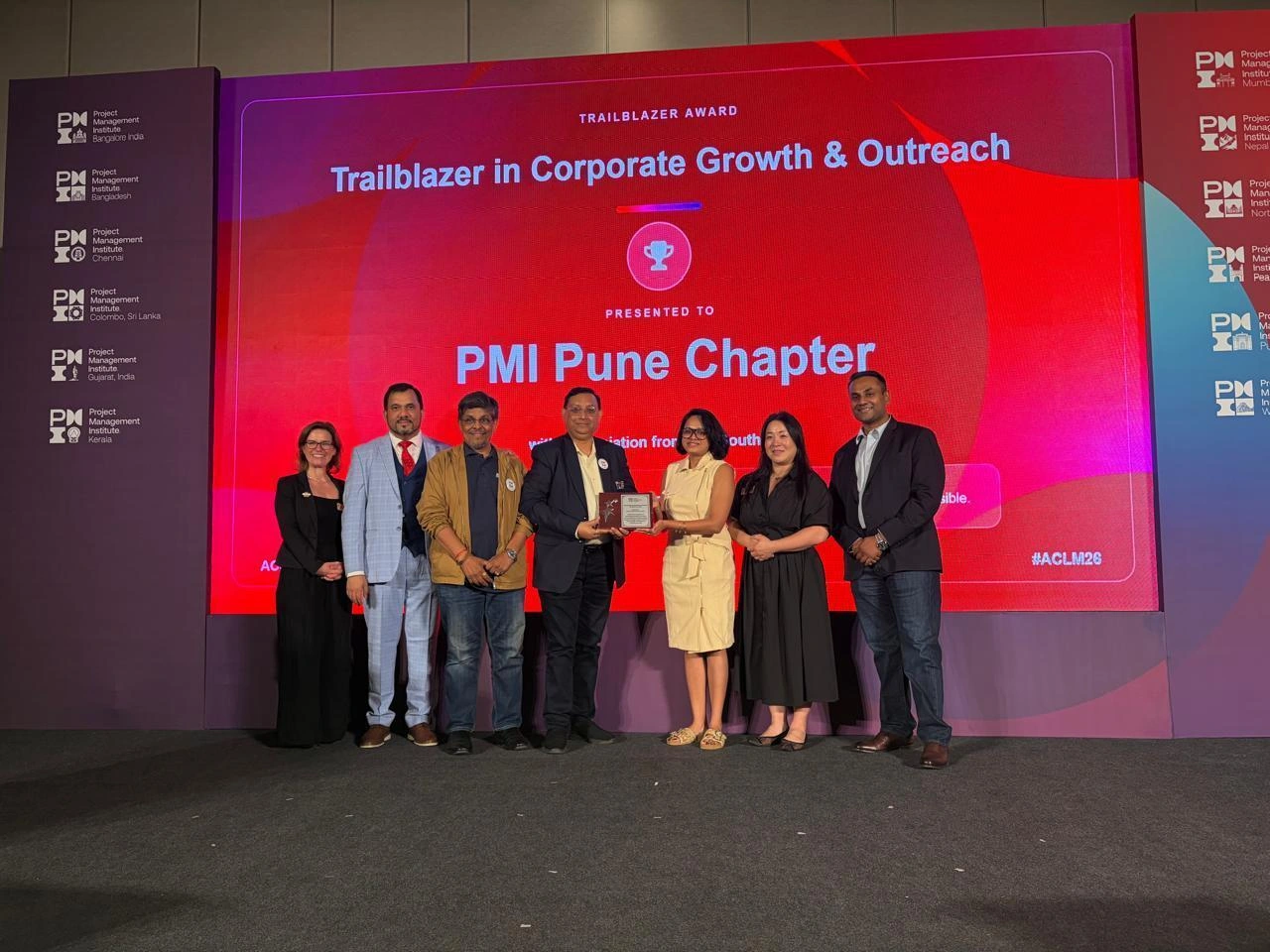
We received an award for corporate achievement, connected with fellow chapter leaders at the PMI South Asia event in Bengaluru, held our 213th Monthly Seminar and launched our Nagpur Branch. A common thread runs through this issue: technology can accelerate delivery, but accountability remains with people, from Pankaj Kulkarni’s AI-enabled critical path to Rinoo Rajesh’s feature on agents on the project team.
Our invitation: An event report is most valuable when it explains what a member could learn. Tell us a practical takeaway, a question that remained unresolved or an experience that changed how you approached your work. If something in these pages sparks an idea, write to us.
As we step into the festival of lights, with Diwali on 8 November 2026, we wish you and your families a joyful, healthy and prosperous Diwali. Shubh Deepavali!
The Editorial Team
Managing Editor

Portfolio & Section Editor | Design & Production

Copy Editing & Fact Checking | Photographs & Contributor Coordination
Send a contribution | publications@pmipunechapter.com
FROM THE PRESIDENT
President’s message
Making membership relevant through learning, relationships and contribution.
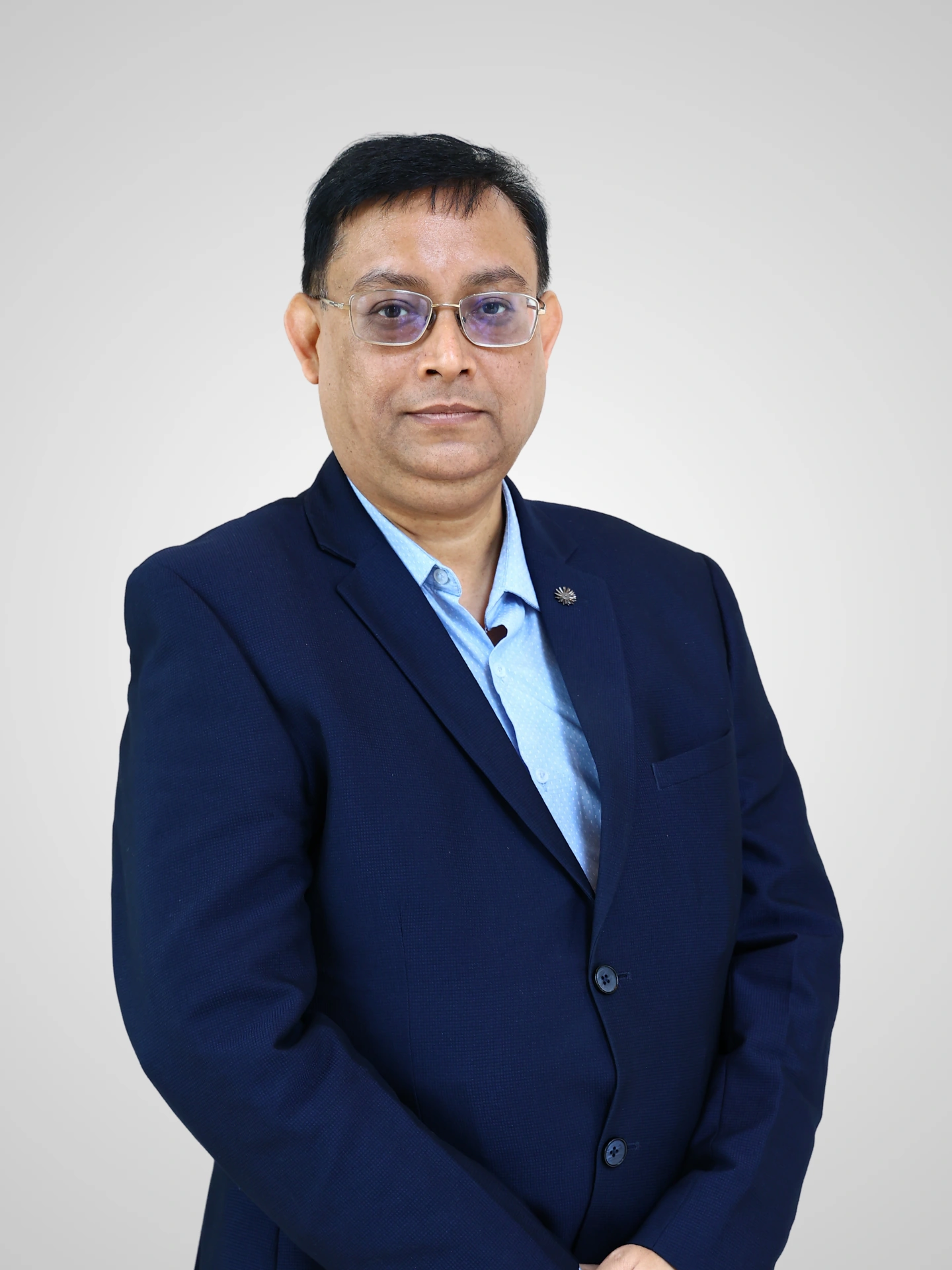
Rinoo Rajesh | President & CEO
 View full size
Dear Members, Volunteers and Partners,
In October, PMI approved the formation of our Nagpur Branch. For members across Vidarbha, that brings the Chapter closer to where you live and work. I’m grateful to the Nagpur volunteers and Board members who helped us reach this point.
The branch creates a local base for learning, networking and volunteering, and for collaboration with industry and academic institutions. Project Vidarbha 2030 in Nagpur showed the appetite for it, as leaders, practitioners and academia discussed how disciplined execution can turn regional ambition into results.
In Bengaluru, at the Annual Chapter Leaders Meet and PMSAC26, the Chapter received the Trailblazer Corporate Growth & Outreach recognition. It reflects sustained work by our volunteers, Board members and corporate partners. One learning I brought home: chapters grow stronger when they learn from one another.
At our 213th Monthly Seminar on 10 October, Pankaj Kulkarni showed how AI can help project teams spot changes to the critical path earlier. The Construction & EPC SIG then explored how digital tools can support more sustainable project delivery. Thank you to the speakers and volunteers who made both discussions possible.
Behind every milestone are people who gave their time and effort. Thank you to everyone who contributed this month.
If you live or work in Vidarbha, what project challenge would you like to discuss with local peers? Share one idea through Member Support in the Chapter Access Hub. I’d welcome your help in shaping what the branch does first.
Warm regards, Rinoo Rajesh President & CEO, PMI Pune–Deccan India Chapter
Save the dates: CxO Conclave, 27 November 2026 | DISHA, 29–30 January 2027
OCTOBER AT A GLANCE
October highlights
The month’s milestones in brief, each covered in full later in this issue.
- Nagpur Branch and Project Vidarbha 2030: the Chapter moved closer to project professionals across Vidarbha, with leaders, academia and practitioners gathering in Nagpur.
- 213th Monthly Seminar, 10 October: Pankaj Kulkarni on AI and the critical path, followed by a Construction & EPC SIG panel on digitalization and sustainable EPC projects.
- PMSAC26, Bengaluru: the Chapter received the Trailblazer Corporate Growth & Outreach recognition.
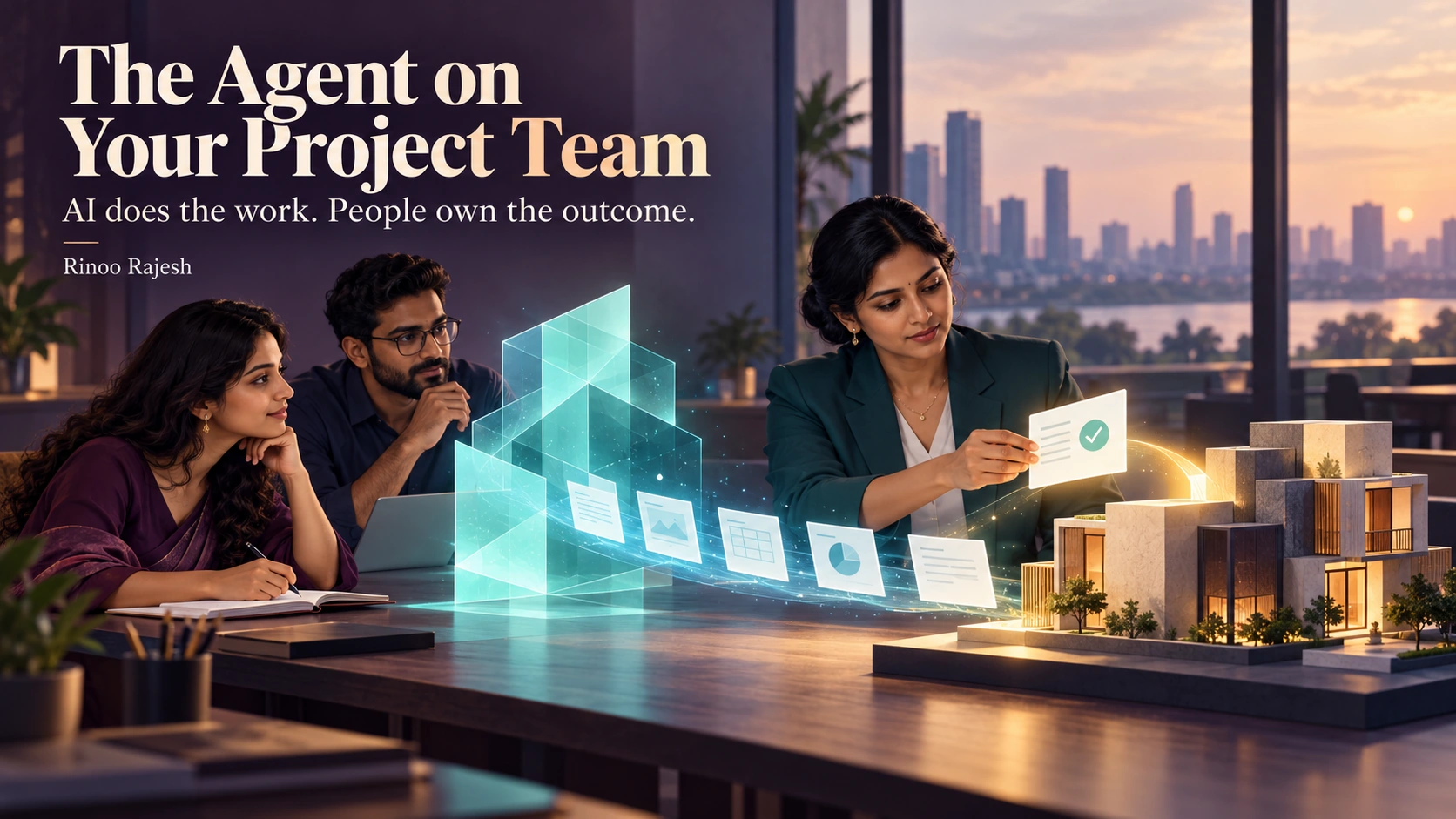
- Feature: “The Agent on Your Project Team” by Rinoo Rajesh, on leading work when part of the team isn’t human.
- Coming up: CxO Conclave on 27 November 2026 and DISHA on 29–30 January 2027. Next issue submissions close on 20 November 2026.
UNDERSTANDING YOUR PROFESSIONAL COMMUNITY
PMI and the project profession
Global knowledge and credentials, connected with local professional practice.
Project Management Institute (PMI) brings together a worldwide community concerned with how projects create value. Its purpose is to maximize project success to elevate our world. For practitioners, that translates into standards, professional credentials, research, learning and opportunities to exchange experience beyond an individual employer or industry.
A common language for project work
Standards and practice resources help professionals discuss delivery with greater precision. Credentials such as PMP®, CAPM® and PMI-ACP® provide recognized development pathways, while continuing learning helps practitioners keep their knowledge relevant as responsibilities and delivery environments change. A credential is one part of a professional journey, alongside experience, judgement and the ability to work effectively with others.
Learning throughout a career
PMI’s published membership offering includes professional resources, premium webinars and special access to PMI Infinity, its AI-powered project-management coach. The appropriate resource depends on the question you are trying to solve. A practitioner building foundational knowledge will use the ecosystem differently from a portfolio leader examining governance or a project manager preparing for a new role.
PMI’s current benefits and access conditions should be checked through the official membership pages. The Chapter’s role is to help members connect those global resources with local professional relationships and practical learning opportunities.
Where the local Chapter fits
PMI Pune–Deccan India Chapter provides a regional community in which members can meet peers, hear practitioners, participate in specialist conversations and contribute through volunteering. A seminar can introduce a new idea; a SIG can examine how it applies in an industry; mentoring can help a member think through its relevance to a personal development goal.
Global PMI resources and Chapter participation work well together when you begin with a specific need. Identify the capability or challenge you want to address, choose a relevant resource and use the community to compare interpretations and experiences. This makes professional development an active process rather than a collection of disconnected activities.
Explore PMI membership and benefits |https://www.pmi.org/membership
Explore PMI standards| https://www.pmi.org/standards
INTRODUCING PMI PUNE–DECCAN INDIA CHAPTER
What the Chapter does
A volunteer-led professional community connecting learning with practice.
Chartered in 2005, PMI Pune–Deccan India Chapter advances project, programme and portfolio management through a regional community of practitioners, leaders, educators, students and partners. Its work combines professional development with the relationships through which people learn, collaborate and contribute.
The Chapter in this reporting period
This issue covers October 2026, with selected earlier achievements identified separately. The community brings together people with different professional responsibilities and interests, giving members several ways to find relevant peers and contribute.
| Offering | What it enables |
|---|---|
| Professional development | Certification pathways, workshops, masterclasses and continuing learning. |
| Programmes and events | Monthly seminars, the DiSHA conference, leadership forums and practitioner exchange. |
| Industry communities | Automotive & Manufacturing, Construction & EPC, and AI & GCC SIGs. |
| Career and inclusion | MentorPRO, CareerConnect and Pune Women’s League. |
| Academic engagement | Institutional collaboration, student clubs, faculty interaction and campus-to-career connections. |
| Contribution and service | Volunteering, publications, social impact, member support and collaboration space. |
How the work is organized
The Board provides direction and oversight. Portfolio leaders and volunteers organize delivery across programs, membership, professional development, corporate and academic engagement, technology, communications and social purpose. This structure connects individual contributions with a wider programme of Chapter activity.
For a member, the most useful entry point is the one that matches a current goal. You do not need to engage with every offering at once. Start with a learning need, an industry question or a contribution you can make, then build a more sustained relationship with that part of the community.
Start with the Member Access Hub | https://www.pmipunechapter.com/landing-pages/new/
YOUR MEMBERSHIP IN PRACTICE
Member benefits and how to use them
Choose the benefit that matches your next professional goal.
Membership is most valuable when it changes what you can learn, whom you can learn with and how you can contribute. The global PMI offering and the Chapter’s local programs provide complementary routes. Access, prices and eligibility vary by service; use the published terms for the specific activity.
| Your goal | A useful starting point | Put it into practice |
|---|---|---|
| Build knowledge | PMI resources and Chapter learning | Choose a topic linked to a live project or capability gap. |
| Maintain a credential | Eligible learning and giving-back activities | Check PDU eligibility and retain the activity evidence. |
| Find peers | Seminars, SIGs and networking | Bring a specific question and follow up with people you meet. |
| Develop through guidance | MentorPRO | Identify the transition or development goal you want to work on. |
| Explore career options | CareerConnect and PMI Job Board | Review the available service and control what information you share. |
| Build leadership experience | Volunteer roles and programme delivery | Agree on a realistic responsibility and complete it well. |
| Increase professional visibility | Speaking, publications and PWL | Share experiences that other members can learn from. |
| Access practical support | Hub onboarding, resources and support | Use the appropriate route and provide the context needed to help you. |
Make a small plan for your membership
Select one learning priority and one community activity for the month ahead. Attend with a question, record what you learned and identify the next action. If the activity did not address your need, tell the relevant team what would have made it more useful.
For credential maintenance, PMI distinguishes Education PDUs from Giving Back to the Profession. Training, webinars and suitable learning activities can support the first category; eligible volunteering, mentoring and content creation may support the second. Requirements depend on the credential and the activity—participation alone is not a blanket assurance of credit.
Check PMI’s current membership benefits | https://www.pmi.org/membership
Understand eligible PDU activities |https://www.pmi.org/certifications/certification-resources/maintain/earn-pdus
DIGITAL MEMBER SERVICES
Your Member Access Hub directory
A practical route from reading about an opportunity to taking part.
The Chapter Access Hub brings member journeys, resources, and support and programme routes into one place. Use it when you know what you need but are unsure which team or service to approach. The directory below maps the named routes visible in the supplied Hub material to the relevant coverage in this issue.
Use the route that matches your purpose
For a first visit, begin with Member Onboarding. For a document or guidance route, choose Member Resources. For an unresolved question, choose Member Support. Programme routes lead to the relevant offering; they do not replace the published eligibility, cohort, and event or booking conditions.
The individual programme pages that follow explain the offering, identify activity recorded for this issue and suggest a practical next step.
MEMBER ONBOARDING RESOURCES AND SUPPORT
Getting started and getting help
Three Hub routes help members find their way into the Chapter.
Member Onboarding
Joining the paid member family is the beginning of a relationship with the Chapter. The onboarding route introduces PMI, the local community and ways to participate. Its purpose is to help members move from registration to a useful first action: finding a relevant session, exploring a specialist group or understanding where to ask for help.
The Hub provides a published gateway into the Chapter and supports ongoing attention to onboarding and engagement. This regular update gives the Membership team a place to share orientation dates, welcomes and useful guidance.
Member Resources
The resources route brings together documents, decks, useful links and member-facing guidance. Start with the question you want to answer. If you need information about a programme, look for its current description and participation route; if you need help understanding the Chapter, begin with the orientation material.
Member Support
The support route provides enquiry and request options, Chapter office information and a complaint route. Give the team enough context to act: the service involved, the date of your request, the issue you encountered and the outcome you need. Avoid including unnecessary personal or payment information in an open message.
Digital support should also make human assistance easier to reach. The Chapter has described conversational-bot and CRM foundations, while multilingual support, voice functions and richer analytics remain future-development targets rather than completed capabilities.
PROFESSIONAL DEVELOPMENT AND TRAINING
Training that supports professional growth
Certification preparation and practical capability building deserve a distinct account.
The Chapter’s professional-development offering covers more than attendance at events. Certification preparation provides a structured route towards a professional credential; skills workshops and masterclasses help practitioners address responsibilities. Both should be selected with a clear development goal.
The training offering
The Chapter’s published training menu includes CAPM®, PMP®, PgMP® and PfMP® preparation, alongside leadership development, agile project management, high-performance teams, personal branding, office tools and ChatGPT in project management. The Chapter also offers capability-development conversations for organizations and PMOs. These describe the offering; they do not establish that every course ran during the reporting period.
Delivery recorded for this issue
This issue’s learning account includes October monthly seminar, SIG discussion and Member Contribution articles.
How members can benefit
Choose a course according to the capability you need and the prerequisites you meet. Before registering, check the syllabus, facilitator, format, dates, fees, cancellation conditions and any stated contact-hour or PDU eligibility. After the programme, record one change you can make in practice and retain the evidence relevant to your certification needs.
MONTHLY PROGRAMMES AND NETWORKING
The 213th monthly seminar: from static schedules to living project intelligence
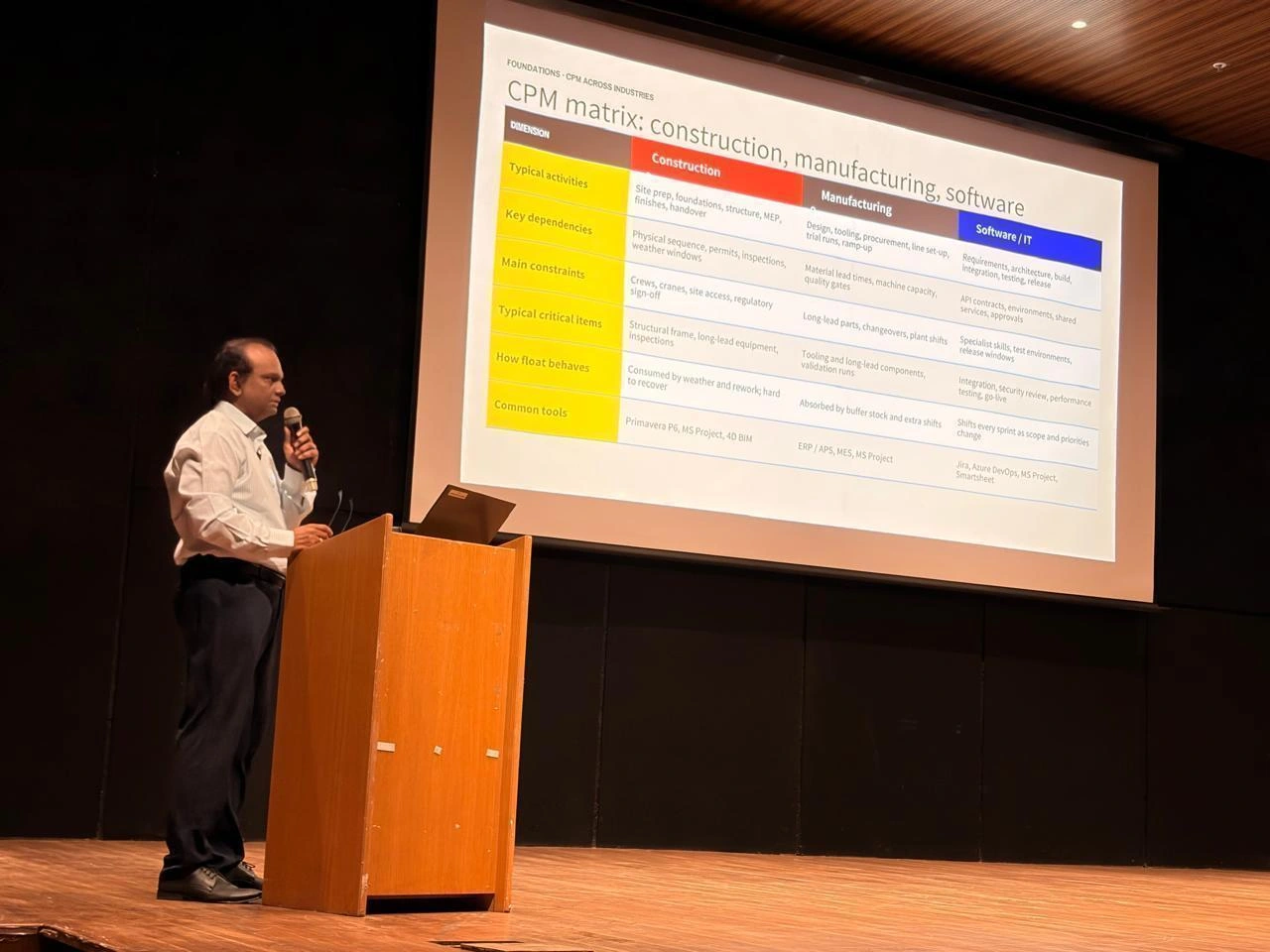
10 October 2026 • Pankaj Kulkarni • “The Critical Path Reimagined: AI for Dynamic Projects”
The Chapter’s 213th Monthly Seminar continued the recurring practitioner-learning format on 10 October 2026. The agenda combined a President’s message, keynote learning, Chapter announcements and member recognition, a networking break, a Construction & EPC SIG panel discussion, a PMI-CP segment and a vote of thanks.
Speaker
Pankaj Kulkarni, Program Manager at ZiMetrics Technologies, was introduced with more than 25 years of technology experience across healthcare, finance, payments and e-commerce. The deck highlights experience in AWS cloud strategy, partnerships, funding programmes, DevOps and Databricks, as well as work associated with AWS competencies and technical-team development.
 View full size
Why the critical path still matters
The keynote began with the foundation of Critical Path Method: the longest chain of dependent activities determines the shortest possible project finish date, and work on that chain has zero float. In practical terms, CPM identifies where time is non-negotiable, where scarce resources deserve attention and where shrinking float can provide an early warning of slippage.
The session placed the same logic across construction, manufacturing and software. In construction, physical sequencing, permits, inspections, weather windows, crews, cranes and long-lead equipment shape the path. In manufacturing, material lead times, capacity and validation dominate. In software, shared services, environments, approvals and integration can cause the critical path to move quickly as scope and priorities change.
From a fixed schedule to a continuously updated control loop
The central argument was that static plans become less reliable as dependencies shift, priorities change and risks emerge between status meetings. The deck describes an evolution from CPM and desktop planning tools through Agile, enterprise PMOs, predictive analytics and generative AI toward “autonomous project intelligence”— systems that do more than record work by predicting, recommending and, within guardrails, acting.
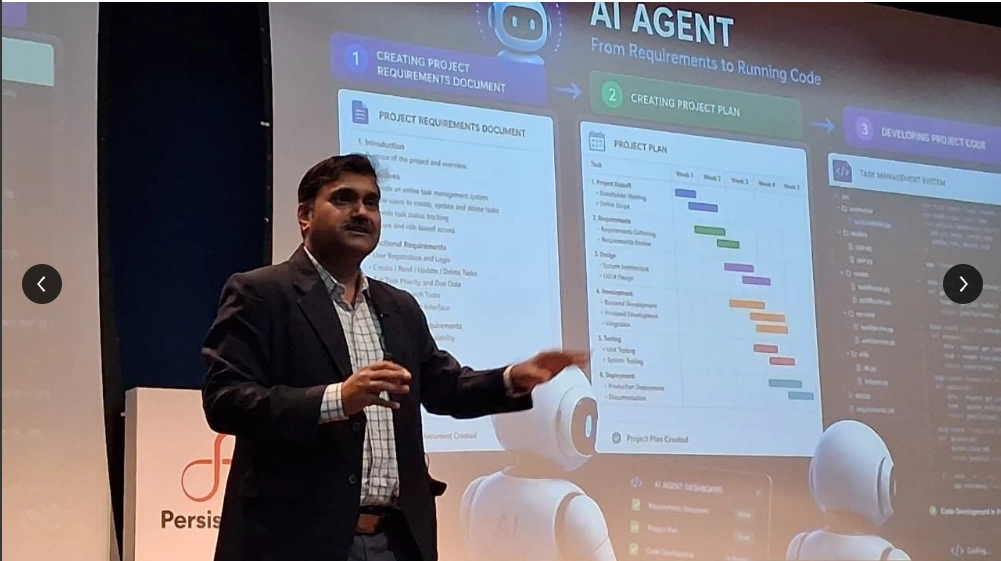
A simple comparison illustrates the shift. In a traditional reporting cycle, a task can slip on Tuesday and only surface in Friday’s status meeting. In the AI-enabled model described in the deck, the network can be recalculated
the same day, the emerging critical path can be identified, and an alert can bring the delivery risk forward while action is still possible.
What AI adds to CPM
- Real-time recalculation as progress changes rather than waiting for periodic manual schedule updates. ●Predictive delay warnings based on patterns from past and current project data. ●Faster what-if analysis across alternative sequences, resources and dates. ●Reduced manual status effort, allowing planners and project managers to spend more time on decisions
and trade-offs. ●Closer links between schedule changes, cost and resource implications.
The cautions matter as much as the capability
The session did not present AI as a substitute for project judgement. It identified clear disadvantages and control concerns: poor data can produce confidently wrong outputs; black-box reasoning can be difficult to defend in audits or delay claims; integration across ERP, Jira, BIM and field systems takes effort; over-reliance on automation can weaken planning skills; and project, cost and people data introduce security and privacy considerations.
The continuous update loop
The proposed future-state loop is straightforward: capture actual progress from project systems, recalculate the network, flag path shifts and float erosion, forecast likely finish and cost outcomes, and recommend recovery actions such as re-sequencing, fast-tracking, crashing or reassignment. The value lies in making schedule risk visible early enough for leaders to intervene.
What changes for project managers, teams and executives
In the model presented, project managers spend less time chasing status and editing dates and more time reading alerts, resolving trade-offs and engaging stakeholders. Teams update work in the systems where delivery happens, reducing duplicate reporting. Executives receive a more current view of delivery-date risk and can ask for decisions earlier rather than reacting to a polished but already stale status report.
Key takeaway
The future of project management is not about managing a static critical path; it is about using AI to continuously discover, predict and optimize the critical path as projects evolve.
MONTHLY PROGRAMMES AND NETWORKING
Expert Panel Discussion - Construction & EPC SIG
10 October 2026 • Ar. Manali Deshmukh •Sagar Chandre • Sagar Chandre •Mr. Vishal Fiske
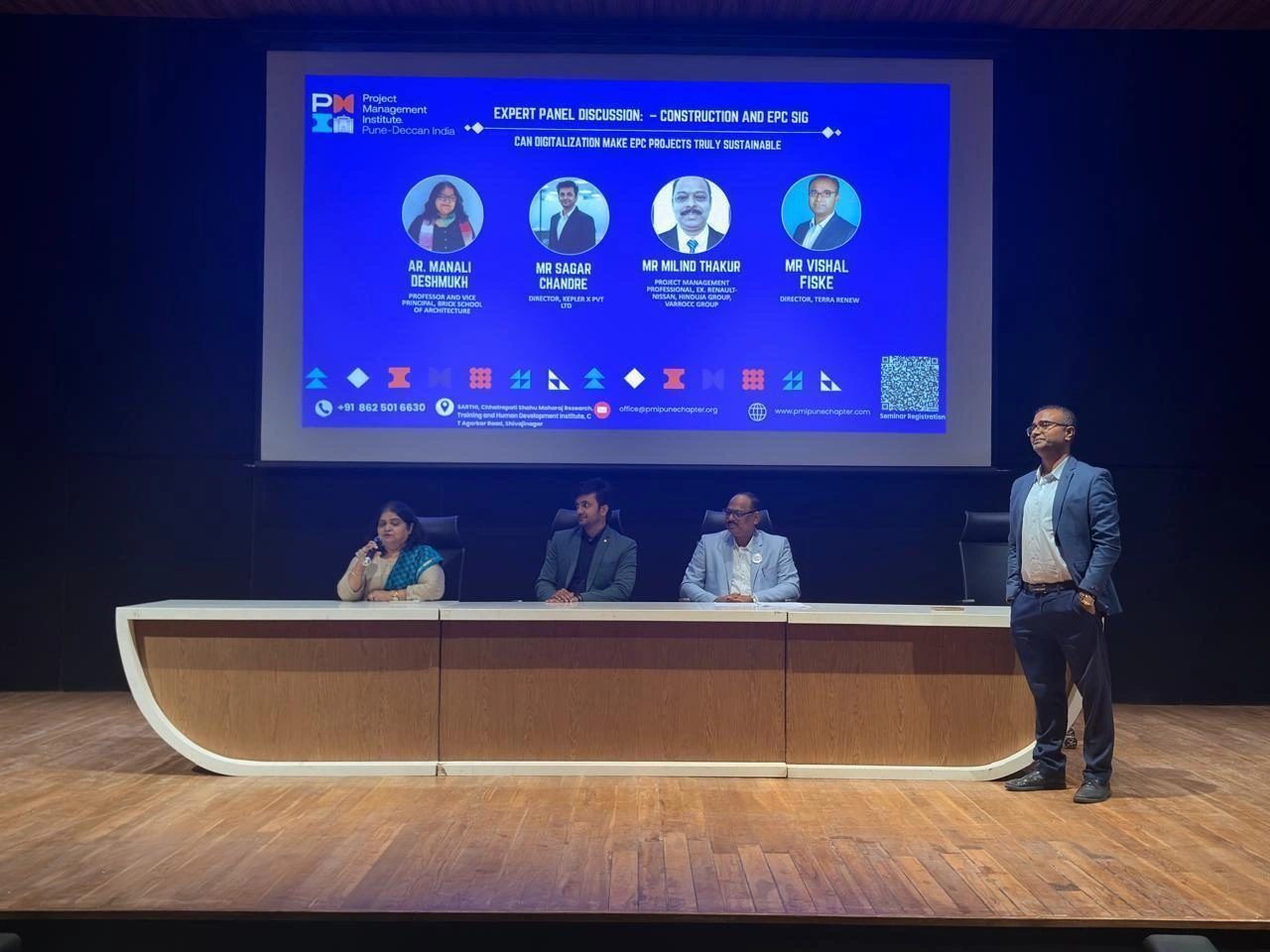
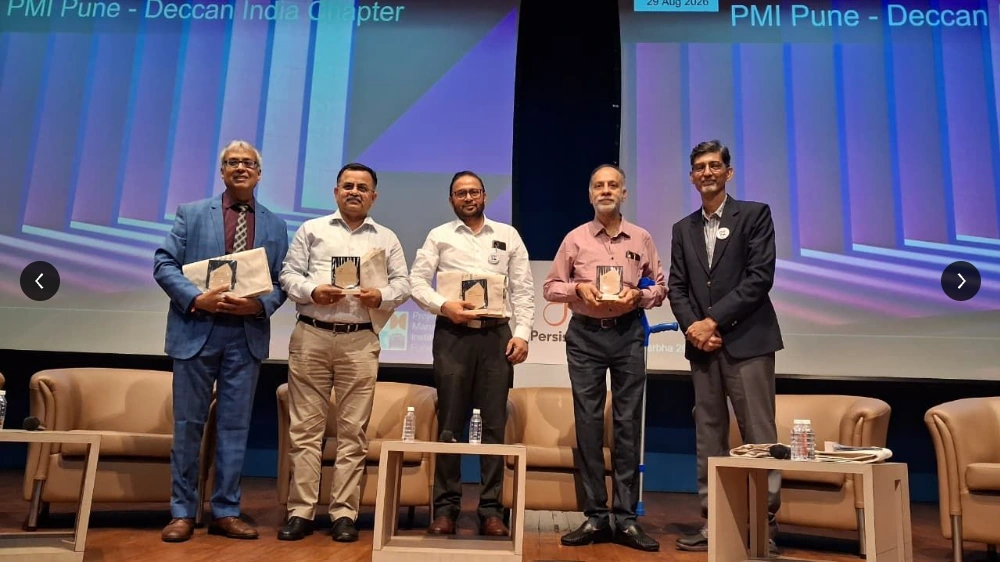
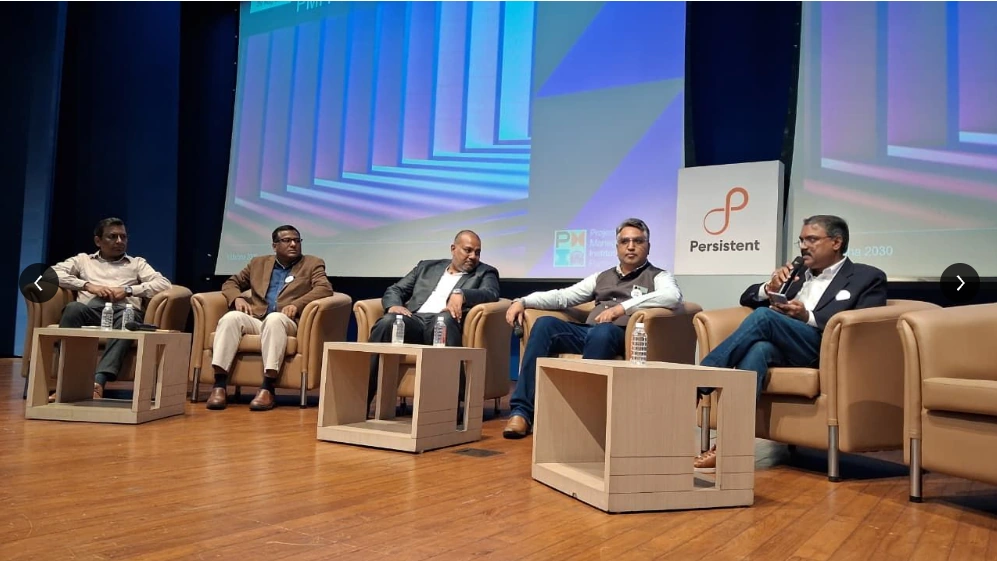
The Construction & EPC SIG brought together practitioners and academia for an engaging panel discussion on “Can Digitalization Make EPC Projects Truly Sustainable?” The discussion featured Ar. Manali Deshmukh, Professor and Vice Principal, BRICK School of Architecture; Mr. Sagar Chandre, Director, Kepler X Pvt. Ltd.; and Mr. Milind Thakur, Project Management Professional, Varroc Group, with Mr. Vishal Fiske, Director, Terra Renew, hosting the session. The panel explored the growing role of digitalization in shaping more sustainable EPC projects, bringing perspectives from architecture, technology, project execution and renewable energy. The conversation highlighted how stronger integration of digital tools, data-driven decision-making and cross- functional collaboration can help project teams rethink planning, execution and long-term sustainability across the EPC lifecycle.
 View full size
Learning and networking in the same setting
As in earlier editions, the seminar format also creates a setting for peer conversation, Chapter announcements, recognition and networking. The agenda’s “Chai Pe Charcha” break reinforces the publication’s recurring
reminder that the value of an event includes what members compare, question and follow up after the formal presentation.
REGIONAL PROJECT LEADERSHIP
Project Vidarbha 2030: from regional potential to executed outcomes
Nagpur • A region-focused project leadership initiative
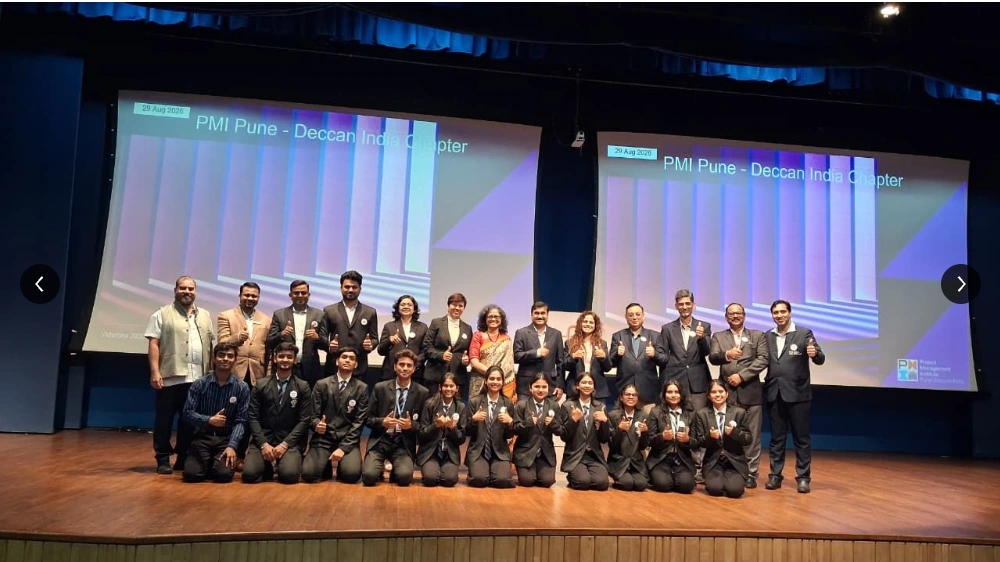
PMI Pune-Deccan India Chapter’s Project Vidarbha 2030 – Nagpur brought together project management professionals, industry leaders, academic institutions and the wider professional community to explore how collaboration, innovation and disciplined execution can help shape Vidarbha’s future. The programme focused on translating strategic ambition into measurable outcomes, building future-ready talent and strengthening connections across industry, academia and the project community.
 View full size
Project Vidarbha 2030 brought together leaders, practitioners, academia and the professional community in Nagpur.
A beginning rooted in tradition
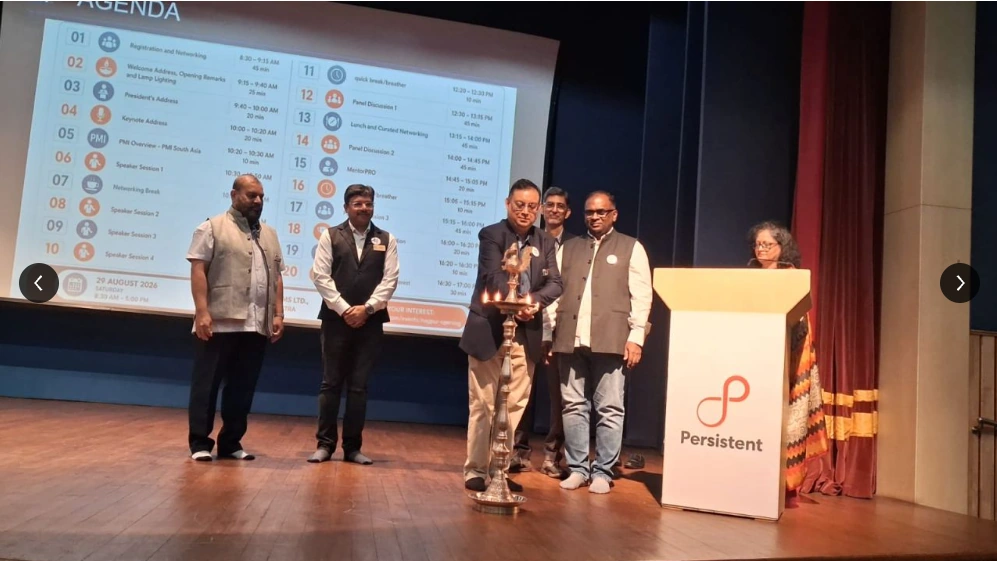
The event opened with an auspicious lamp-lighting ceremony, symbolizing knowledge, collaboration, leadership and a shared vision for the future. The ceremony was graced by Avinash Samrit, Abhishek Sharma, Rinoo Rajesh, Jay Dholakia and Girish Kadam.
 View full size
PROJECT VIDARBHA 2030
Leadership, strategy and collaboration
Nagpur 2030: converting strategic advantage into executed outcomes
Chief Guest Avinash Samrit highlighted the importance of strategic project leadership, disciplined execution and collaboration in turning regional vision into measurable impact.
From Pune to Vidarbha: building a statewide movement
Rinoo Rajesh, President, PMIPDIC, shared the vision of extending project leadership across Maharashtra and strengthening the project management ecosystem in Vidarbha—building a community of capable, connected and outcome-driven project leaders.
Industry and academia: navigating change together
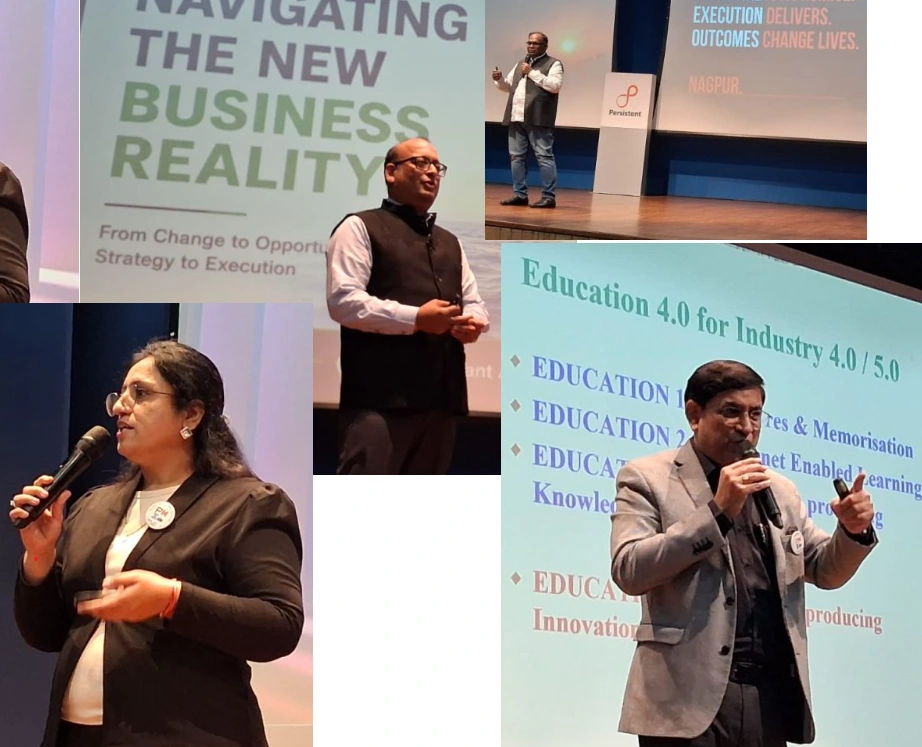
Dr Prashant Agrawal (VIA) shared perspectives on opportunities for institutions and industry forums in a changing business environment. Dr Vivek Nanoti, Director Engineering, Priyadarshini College, spoke on bridging the industry–academia gap through skills, innovation and collaboration.
 View full size
Perspectives on strategy, industry and academia.
Bridging strategy and execution
Mili Juneja explored how organizations can turn strategic intent into focused action by aligning people and priorities and building the discipline required to deliver measurable outcomes.
Understanding PMI and the project profession
Abhishek Sharma, Chapter Engagement Manager – South Asia, presented an overview of PMI and its role in developing a global community, strengthening professional skills, enabling collaboration and creating opportunities for project leaders.
PROJECT VIDARBHA 2030
The conversations shaping 2030
Three inspiring books: leadership, technology and life
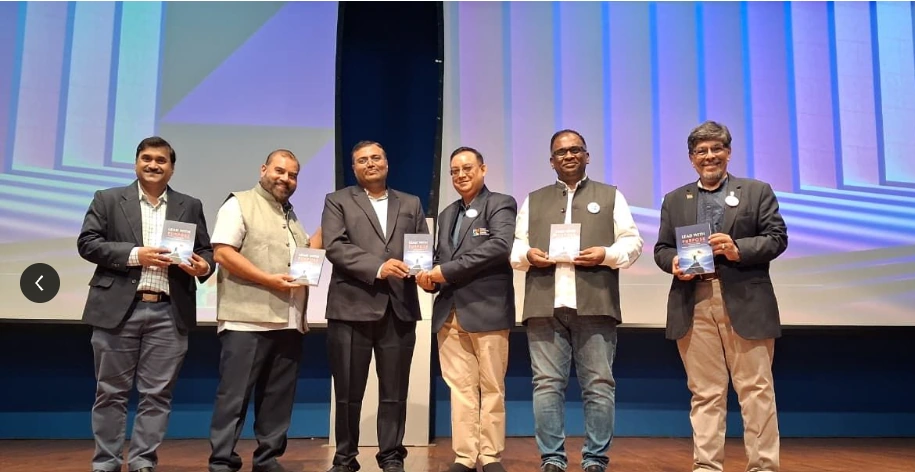
The event also celebrated the launch of three books, each offering a distinct perspective on leadership, technology and life:
- • “Lead with Purpose” by Anand Moharikar
- • “Beyond GenAI – Rise of Agentic AI Based Autonomous Systems” by Rinoo Rajesh
- • “With the Light of Soul – A Ramble Through Life” by Aditi Chouhan
 View full size
Three books launched during Project Vidarbha 2030.
Future-ready talent: from degrees to delivery
Moderated by Anita Singh, the panel explored how Nagpur can prepare young people not only to earn degrees, but also to deliver real-world outcomes. Dr Ashutosh Paturkar (GHIMR), Dr Chandan Vichoray (Ramdeobaba University), Dr Indu Mazumdar (NADP), Dr Satyendra Deshmukh and Prof Alok Kumar Singh (IIM Nagpur) discussed employability, industry–academia collaboration and the skills needed for a changing project economy. The central message: future-ready talent needs communication, collaboration, problem-solving, adaptability, technology awareness and the ability to turn knowledge into delivery.
AI for project managers: from hype to harnessing
Rahul Sudame explored practical ways AI can support better and faster decisions, improve productivity, identify risks and opportunities earlier and augment human expertise. The discussion emphasized combining AI capability with human judgement.
 View full size
AI for project managers: practical adoption with human judgement.
Is on-time and on-budget still enough?
The panel on “The Value Shift” examined how project success is evolving beyond scope, schedule and cost to include business value, resilience, sustainability, innovation, customer impact and lasting competitive advantage. Narendra Satfale (Mahindra & Mahindra), Nitin Bagokar (Bajaj Steel Industries), Rahul Bagdia (pManifold Business Solutions), Utkarsh Khopkar (Sun Enviro Technologies) and Jay Dholakia shared perspectives on what meaningful project success should look like.
 View full size
The Value Shift panel explored success beyond scope, schedule and cost.
PROJECT VIDARBHA 2030
The future of PMOs - and the people behind the progress
Digital engineering and the AI-driven PMO
Moderated by Amit Kale (GlobalLogic), this panel explored how AI, digital engineering, data and intelligent automation can help PMOs evolve from governance and reporting functions into strategic partners connecting business vision with execution. Shailesh Awale (HCLTech Nagpur), Navin Gnaneshwar (Novartis), Dr Rizwan Ahmed (Delaplex) and Shailesh Wadhankar (Nice Software Solutions) discussed predictive insights, intelligent automation, portfolio visibility and AI-assisted decision-making. The discussion underlined that people, processes, leadership, data and technology must evolve together.
 View full size
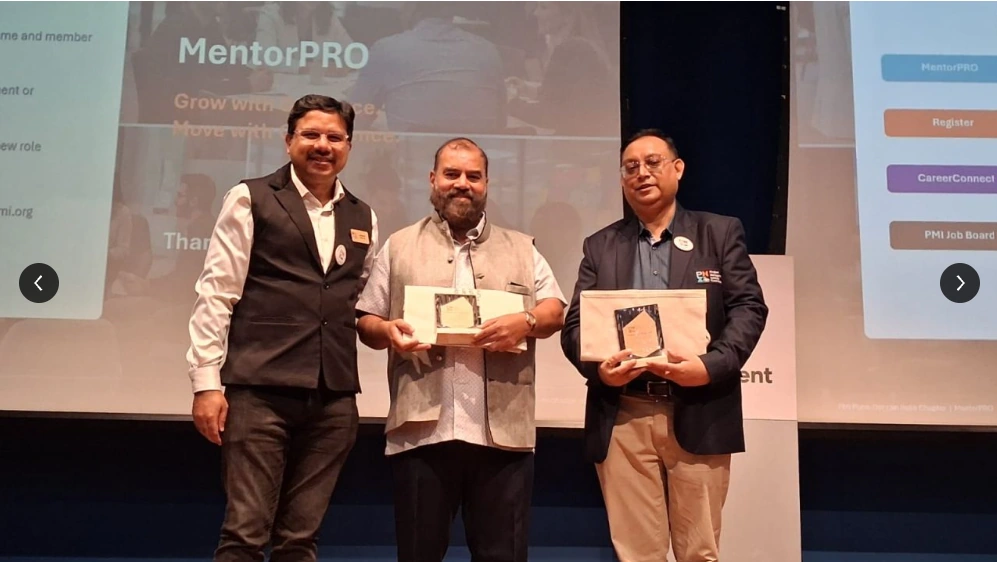
Mentorship that strengthens the profession
 View full size
The PMI MentorPRO initiative connects experienced project management professionals with emerging practitioners for one- to-one guidance, knowledge exchange, professional networking and career development—creating value for mentees, mentors and the wider industry by connecting experience with ambition.
Celebrating the people behind Project Vidarbha 2030
The event recognized the volunteers, speakers, guests and contributors whose time, expertise and commitment helped make the initiative meaningful. Their collective effort is helping build a stronger, more connected project management ecosystem across Vidarbha.
A meaningful close—and a continuing journey
Vivek Sonar delivered the closing remarks and vote of thanks, acknowledging the guests, speakers, volunteers, participants and PMI community. The event closed with a shared commitment to collaboration, learning, leadership and innovation.
FROM IDEAS TO ACTION • FROM COLLABORATION TO IMPACT • TOWARDS A STRONGER VIDARBHA
Learning Across Chapters, Contributing Across South Asia - PMSAC26 Event
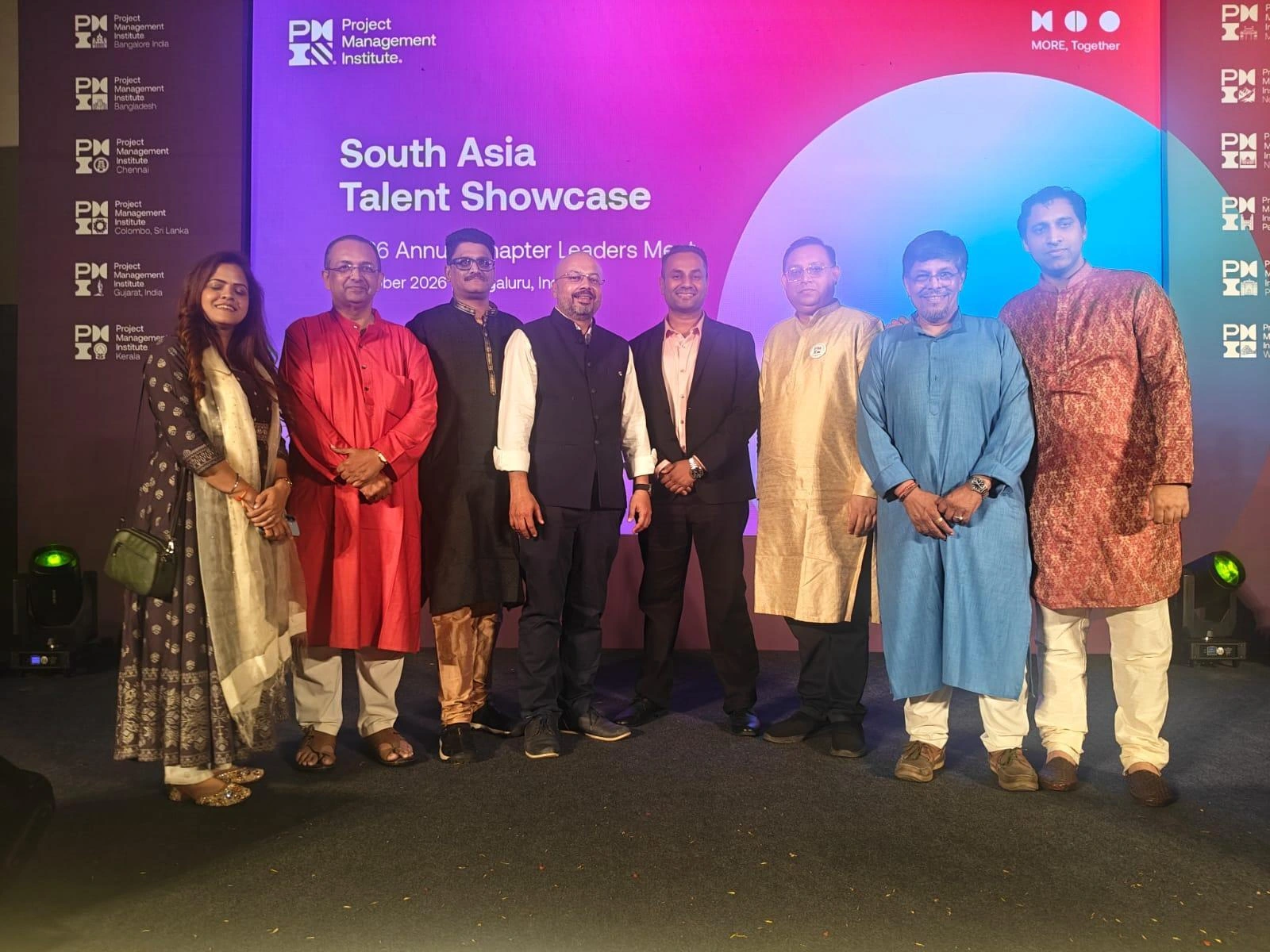
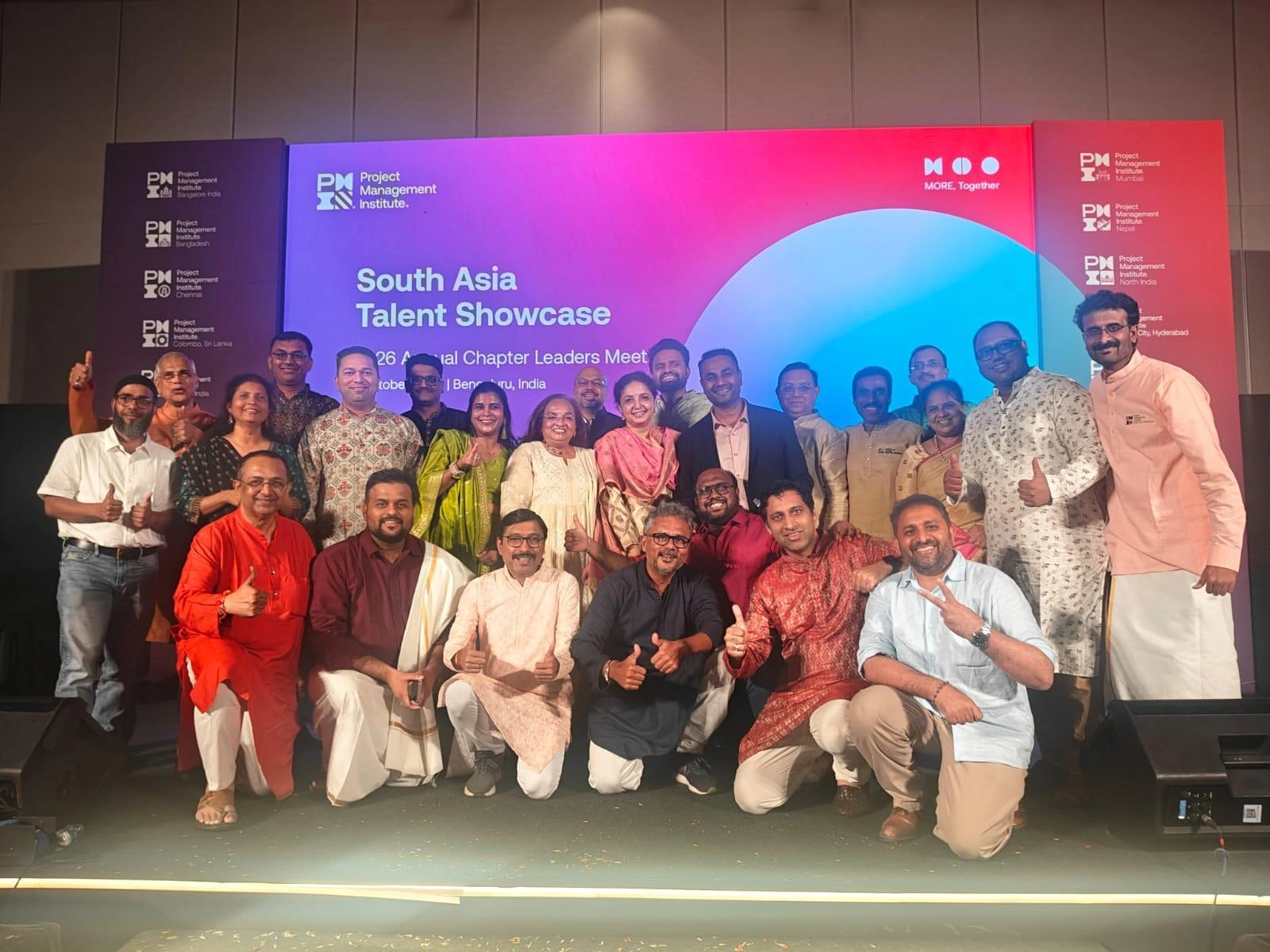
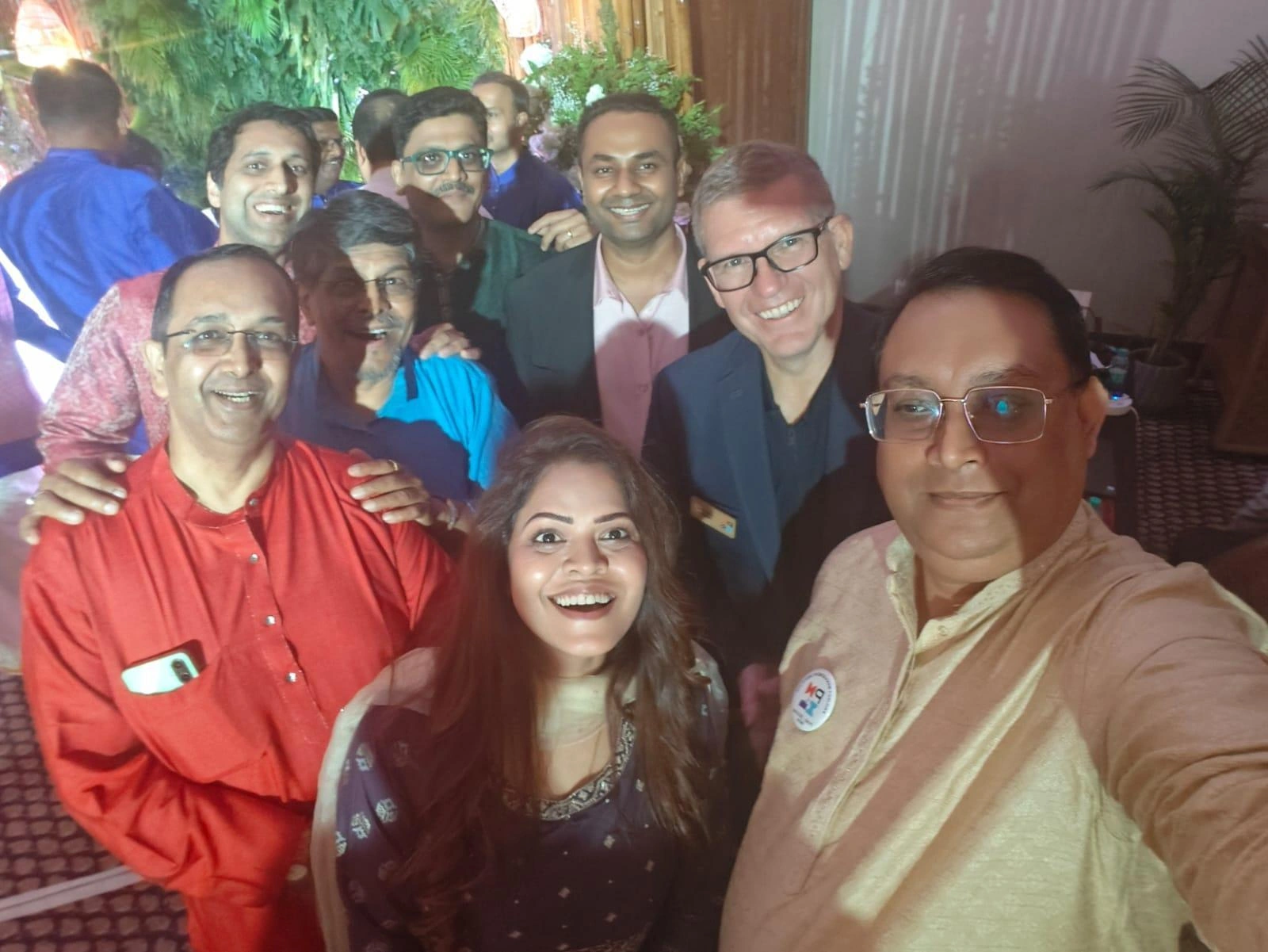
PMI Pune-Deccan India Chapter joined chapter leaders from across South Asia in Bengaluru during the Annual Chapter Leaders Meet and PMSAC26, part of three days of leadership, knowledge-sharing and professional- community engagement.
The 2026 South Asia programme placed strong emphasis on future-ready leadership in the age of AI, while the Chapter Leaders Meet created space for chapters to exchange experiences around volunteering, academia, portfolio development and community growth.
For PMI Pune Deccan India Chapter, the engagement also brought a proud moment: the Chapter received the TrailblazerCorporate Growth & Outreach recognition.The acknowledgement reflects the Chapter’s continuing work to build stronger relationships between PMI, industry and the professional community.
Just as importantly, Bengaluru provided an opportunity to learn from fellow chapters, compare approaches and bring fresh ideas back home.
Strong chapters grow locally. Stronger PMI communities grow when chapters learn from one another.
 View full size
 View full size
 View full size
 View full size
The Agent on Your Project Team: Leading Work When Part of the Team Isn't Human
Picture a Monday status review a year from now. The risk log was refreshed overnight. Test cases for the new release were drafted, and three vendor invoices were matched against delivery records. Nobody on the call did any of that work. Agents did.
 View full size
Then the sponsor asks a simple question: "Who signed off on the test coverage?" The room goes quiet. Everyone assumed someone else had checked it.
That silence is the real challenge agentic AI brings to project delivery. Most of the conversation so far has been about what agents can do. Far less has been said about how we plan, staff, estimate and govern a project when part of the team isn't human. Those are project management questions, and project managers are well placed to answer them.
The good news is that we don't need a new discipline. We need to apply the one we already have, honestly, to a new kind of team member.
Put agents in the plan, not around it
Today most agents enter a project informally. A team lead switches one on, it starts producing work, and the schedule never mentions it. That is how the Monday silence happens. If an agent does work on your project, that work belongs in the work breakdown structure like any other deliverable, with an owner, an acceptance criterion and a place in the schedule.
The RACI chart is the simplest place to start. An agent can be Responsible: it drafts the test cases, reconciles the invoices, refreshes the risk log. It can never be Accountable. Accountability needs someone who can be asked to explain a decision, who can be held to it, and who can change course. That is always a named person.
So for every agent task, I'd add one line to the RACI: which person is accountable for the agent's output, and who reviews it before it moves downstream. If nobody wants to put their name in that box, it's a sign the task isn't ready to hand to an agent.
This isn't just good practice. The NIST AI Risk Management Framework expects organizations to have policies that "define and differentiate roles and responsibilities for human-AI configurations and oversight of AI systems."[1] The project plan is where that policy becomes real for a specific piece of work.
One more test is worth applying at planning time: could the project still deliver if the agent were switched off tomorrow? If the answer is no, the agent is a critical dependency, and it needs the same contingency planning you would give a key supplier.
Estimate where the effort really goes
The first estimate for agent-assisted work is almost always wrong in the same direction. Someone sees the agent produce two hundred test cases in ten minutes and cuts the testing estimate by eighty per cent. Three weeks later the team is behind, because nobody budgeted for reading those two hundred test cases.
Agents don't remove effort so much as move it. Less time goes into producing a first draft. More goes into reviewing it, handling the exceptions the agent couldn't resolve, and fixing the errors that slipped through. On some tasks, trade is excellent. On others, checking the work takes nearly as long as doing it, and the gain is mostly illusory.
So, I'd estimate agent-assisted tasks in three parts:
1.Generation - the agent's own run time and cost, usually the smallest number. 2.Review - the human time to check the output to the standard the deliverable needs, which
depends on the risk, not the volume. 3.Exceptions and rework - the cases the agent escalates or gets wrong, estimated from a pilot
rather than a vendor's demo. Track all three as actuals from the first sprint. Within a few iterations you will know whether the agent is genuinely shortening the critical path or just making the team busier in a different place. That number, not the demo, should drive your next estimate.
Watch the review load, in particular. When the same three senior people must approve everything the agents produce, they quietly become the project's bottleneck. Resource plans need to show that load explicitly, with backup reviewers named, in the same way you would plan for a key specialist.
Give agent behavior a line in the risk register
Most project risk registers I see list "AI" once, if at all, usually as a technology risk owned by IT. That misses where the real exposure sits. Agent risks are delivery risks: they show up as rework, missed milestones and decisions nobody can explain to a sponsor.
The security community is already naming them. OWASP's Top 10 for Agentic Applications, published in December 2025, includes "cascading failures" and "human-agent trust exploitation" alongside more technical threats.[2] In project language, the first means one agent's mistake flowing straight into the next agent's input. The second means reviewers trusting confident output they should have questioned. Both are familiar to any PM who has watched a bad assumption travel through a plan.
A few entries I'd expect in any project that uses agents:
| Risk | Early warning sign | Response | Owner |
|---|---|---|---|
| Rubber-stamp reviews | Approval times fall while volumes rise | Sample-check approved items; rotate reviewers | Delivery lead |
| Errors chain between agents | Downstream rework traced to an upstream agent | Add a human checkpoint between hand-offs | Process owner |
| Silent behavior changes after a model or prompt update | Output quality shifts with no project change | Treat updates as changes; re-run acceptance tests | Product owner |
| Agent becomes a single point of failure | Team can no longer do the task manually | Keep a documented manual fallback and practice it | Project manager |
The third row deserves special attention. Changing an agent's model, instructions or tool access can change what it produces as much as replacing a team member would. Those changes should go through the project's change control, with a named approver and a regression check, not be pushed quietly by a platform team on a Friday afternoon.
What GCCs and PMOs should build
India's GCCs are well placed to lead this. A NASSCOM–Zinnov study counted more than 1,700 GCCs in India in FY2024, employing over 1.9 million people.[3] Many of them already run delivery for dozens of global projects at once. That scale makes them the natural home for a shared way of working with agents, rather than every project team inventing its own.
I'd ask the GCC PMO to own an agent delivery playbook, kept short and practical:
- A planning template that puts agent tasks in the WBS and RACI, with an accountable person and reviewer
for each. ●Estimating norms for generation, review and rework, built from actuals across projects rather than vendor
claims.
- A standard set of agent risks for the register, with tested responses. ●A change-control rule for model, prompt and tool-access changes. ●Status reporting that separates agent work from human work, so sponsors can see what was checked and
by whom.
The last point matters more than it sound. A green status built on unchecked agent output is not green. Reports should show how much of the period's work came from agents and what share of it was reviewed. That gives a sponsor the information to ask the right question before the Monday silence, not after.
As in my earlier article on delegating authority, the PMO should own the method, not the business decisions. The accountable person for each deliverable stays with the business or project that owns it. The GCC's job is to make sure everyone is planning, estimating and reporting agents work the same honest way.
PMI's own direction supports this. Its Standard for Artificial Intelligence in Portfolio, Program, and Project Management, published in June 2026, treats governance as part of the delivery work itself and is built around human-in-the-loop oversight at every stage.[4] A GCC playbook is a practical way to put that standard to work.
What changes for the project manager
There is a popular claim that agents will take over much of project management. I think the opposite is closer to the truth. Agents will take over a lot of project administration: updating trackers, chasing status, drafting reports. What's left is the part of the job that was always hardest, and it becomes more important, not less.
Someone still must decide what the agent should and shouldn't do on this project. Someone must judge whether its output is good enough for this sponsor, this customer, this risk. And when something goes wrong, someone must stand in front of the steering committee and explain what happened and what will change. None of that can be delegated to software.
The project managers who thrive will be the ones who treat agents the way a good manager treats any new team member. Give them clear work. Check it properly until they've earned trust. Know their weaknesses. And never let anyone forget who is accountable for the result.
The next time a sponsor asks who signed off on the work, the answer should come immediately, with a name. That is the standard. Agents can help us meet it faster. They can't meet it for us.
References
1.NIST. AI Risk Management Framework 1.0, Core — GOVERN 3.2. 2023. 2.OWASP GenAI Security Project. OWASP Top 10 for Agentic Applications for 2026. December 2025. 3.ANI via ThePrint. India's position as GCC capital of the world: NASSCOM–Zinnov study.
September 2024. 4.PMI. PMI Publishes World's First Global Standard for AI in Project Work. June 2026.
Rinoo Rajesh is Founder and Director of Enrich Technology Services and an author and speaker on AI, enterprise transformation and project leadership.
SPECIAL INTEREST GROUP
Automotive and Manufacturing SIG
Project leadership for mobility, production and industrial transformation.
The Automotive & Manufacturing SIG gives project professionals a setting in which general delivery disciplines meet sector-specific realities. Product development, supplier coordination, plant change and digital transformation all involve different technical constraints, but each requires clear scope, decisions, risks and stakeholder alignment.
What the SIG covers
The SIG’s focus areas include Industry 5.0, mobility, plant excellence, supply chains, AI in manufacturing and digital-factory change. These provide a useful basis for conversations involving manufacturers, suppliers, project offices, operational leaders and technology partners. Roundtables, clinics, site visits and masterclasses provide possible formats; check published announcements for the activities currently offered.
Activity recorded for this SIG
An Automotive & Manufacturing webinar took place on 18 April 2026. Corporate Outreach also reports June and September panels on resilient supply chains and the future-ready PMO in the AI era.
How members can benefit
Bring a delivery question with enough context to support a useful discussion: the type of programme, the decision involved and the constraint you are trying to manage. A lesson about supplier readiness or plant adoption may be more valuable to peers than a general account of organizational success. Protect confidential information and seek permission before sharing identifiable cases.
Members can participate as learners, contributors, speakers or volunteers according to the opportunities offered. An industry specialist can help by translating experience into a practical case; someone new to the sector can begin by listening, asking precise questions and following the discussion over time.
SPECIAL INTEREST GROUP
Construction and EPC SIG
Practical discussion of cost, schedule, contracts and delivery predictability.
Construction and engineering, procurement and construction projects bring together owners, designers, contractors, consultants and specialist suppliers. Decisions made in one part of the project can affect many others. The Construction & EPC SIG offers a professional setting in which members can examine those interfaces and exchange delivery lessons.
What the SIG covers
The SIG’s areas of focus include project controls, contracts and claims, risk, safety, quality, BIM and digital twins, stakeholder governance and AI-supported delivery. The common concern is improving the quality of project decisions and the predictability of delivery. These are discussion themes, not a claim that every topic has already been covered by an event.
Activity recorded for this SIG
Construction & EPC forms part of the Chapter’s cross-SIG programme. This regular section provides a place to capture the community’s sessions, member learning and follow-up opportunities.
This issue later covers the Roundtable discussion happened on Construction & EPC SIG in October Monthly Seminar.
How members can benefit
A useful contribution begins with a project question that others can examine how a change was governed, how an early warning was recognized or how a coordination problem affected schedule and cost. Explain the circumstances and the trade-off and distinguish what the team knew at the time from what became clear later.
Members from planning, project controls, contracts, safety, quality and leadership roles can bring complementary perspectives. Participate in a published session, propose a focused case discussion or offer support with content and programme delivery. Use the Hub route to find the current participation options.
SPECIAL INTEREST GROUP
AI and GCC SIG
Responsible adoption, delivery governance and the changing role of project professionals.
The AI & GCC SIG connects project professionals with the questions raised by artificial intelligence and Global Capability Centers. Its relevance lies in how organizations adopt new capabilities, organize delivery and demonstrate value—not simply in the availability of new tools.
What the SIG covers
Focus areas include generative and agentic AI, human oversight, AI governance, GCC operating models and the AI- enabled PMO. These themes connect technology with project controls, stakeholder expectations and responsible use. They also make room for practitioners who need to understand adoption and change without being AI developers themselves.
Activity recorded under SIG
The current-year SIG programme includes discussion of the project manager’s evolving role in the AI boom. This section gives the AI & GCC team a regular place to share sessions, use cases and learning from members.
How members can benefit
Bring a specific workflow or decision to the conversation. Ask what problem the technology addresses, what information it uses, how its output will be checked and how a team would know whether the change helped. This keeps the discussion connected to professional practice and provides a basis for learning from other member’s experiences.
Members can contribute through cases, discussion, learning content and volunteer support. A useful case explains the limits as well as the benefits of an approach. It should avoid exposing confidential organizational information or presenting an unverified demonstration as a proven result.
MENTORING AND CAREER DEVELOPMENT
MentorPRO for guidance and career transitions
Structured conversations that begin with a clear development goal.
 View full size
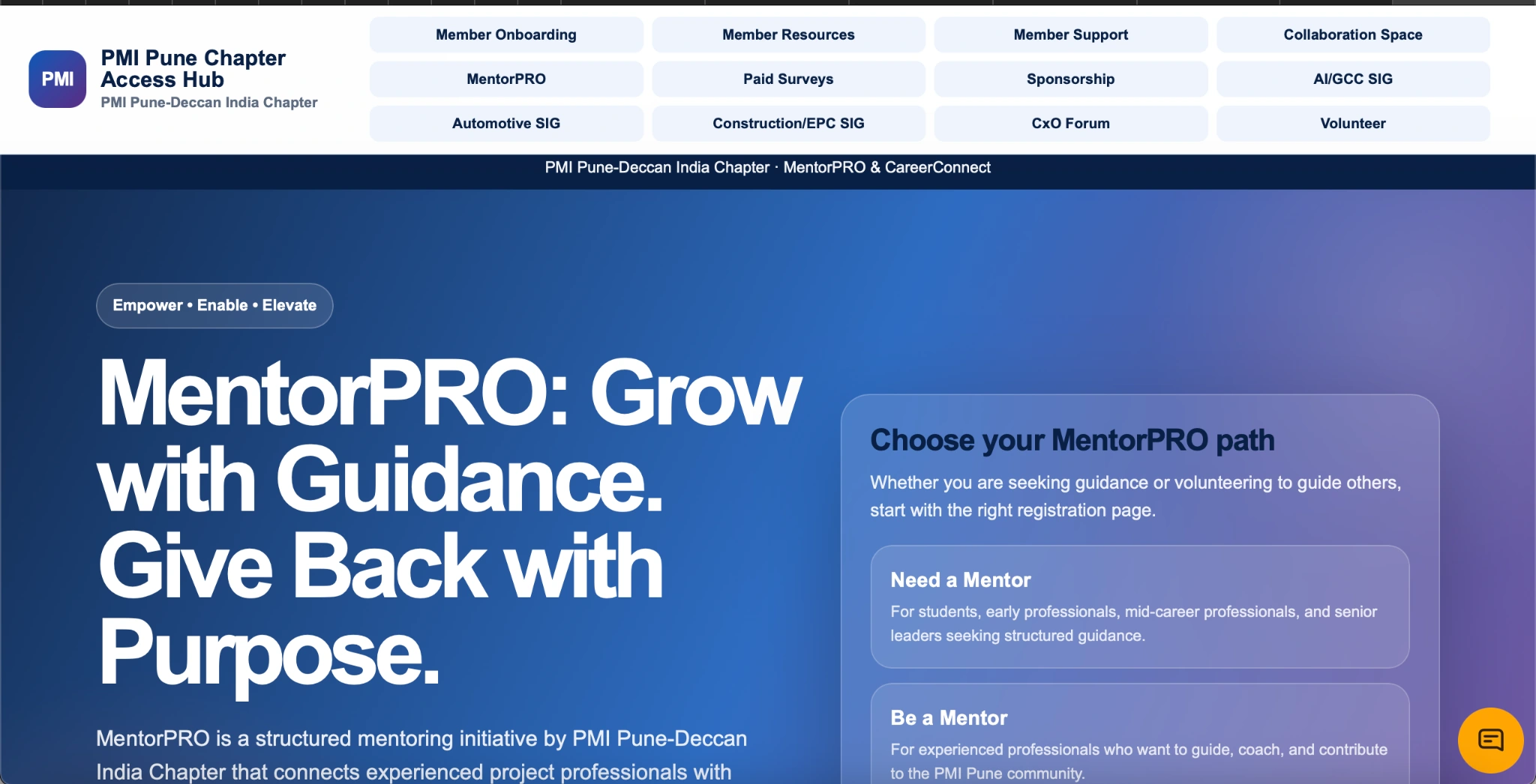
MentorPRO’s member-facing programme page, supplied in the revised draft.
Professional Development launched MentorPRO as a structured mentoring initiative. The programme describes four-to-six-month pathways and matching based on experience, goals and preferences. Members should check the current cohort description for the format and duration applicable to their chosen pathway.
Different needs across a career
The programme architecture includes Student Launchpad, Career Acceleration, Leadership Transition Studio and Mentor Academy. These distinguish support for emerging professionals, members navigating career development, experienced professionals taking on leadership responsibilities and senior practitioners preparing to mentor. Targeted clinics provide a more focused format; check their current scheduling separately.
How to make mentoring useful
Begin with a development question you can explain clearly. Identify the transition, responsibility or capability you want to work on, the context in which it matters and what progress would look like. A mentor can support reflection and learning, while the member remains responsible for decisions and follow-through.
Senior professionals can explore contributing as mentors. The value of that contribution comes from experience shared with care, attentive listening and a commitment to the agreed programme—not from prescribing the same career path for everyone.
CAREER OPPORTUNITIES AND MEMBER PARTICIPATION
CareerConnect and paid survey opportunities
Two distinct routes with different purposes and participation conditions.
CareerConnect and the PMI Job Board
CareerConnect is described in the Chapter offering as a route into career-related opportunities and professional development. The PMI Job Board is a separate global resource for exploring advertised roles. Members should distinguish a career service from a promise of placement and use the published scope of the specific offering.
Before using a career platform, decide what information you wish to share and review the conditions presented. The Chapter’s stated approach is that members elect to share their own information; the Chapter does not release its member database. Any assessment, mentoring or recruitment interaction should be understood on its own terms.
Paid Surveys through the Hub
The Hub includes a Paid Surveys route, giving this activity a visible place alongside other member services. A survey opportunity should state its purpose, participant eligibility, time requirement, data use and any reward conditions. Being listed as an opportunity does not establish that every member qualifies or that payment is guaranteed.
The regular survey update is designed to share active campaigns, eligibility and participation conditions as applicable.
How to benefit responsibly
Use verified programme links, read the participation information and keep copies of relevant confirmations. Share only the information needed for the activity. If the purpose or payment terms are unclear, use Member Support before proceeding.
PUNE WOMEN’S LEAGUE
PWL supports women in project leadership
A place for learning, mentoring, professional visibility and contribution.
Pune Women’s League (PWL) is the Chapter’s women-engagement platform. The Chapter’s published account connects it with the PMI South Asia initiative to understand the challenges faced by women in project management and develop programs that encourage inclusion and participation.
Why a dedicated platform matters
Professional development involves the confidence to contribute as well as the knowledge to do so. A forum where members can share experience, hear role models and discuss career questions creates another route into the Chapter. PWL brings capability, mentoring, visibility, volunteering and inclusive leadership together, with allies welcomed into that purpose.
Ways members can take part
PWL’s published themes include skill development, networking, and knowledge sharing, mentoring and professional or social volunteering. Leadership confidence and opportunities to contribute are central to that purpose. These describe the platform’s purpose and possible formats; current events and programme availability should be checked with the team.
A member might begin by attending a discussion, bringing a development question, offering a practical experience or volunteering to help deliver an activity. An experienced practitioner can contribute as a role model or mentor; someone earlier in a career can help identify questions that deserve greater attention.
Activity for PWL
This dedicated section gives PWL a regular place in Member’s Dialog. Regular updates can share the activities delivered, the lessons members took away and the opportunities to participate next.
GIVE BACK AND BUILD CAPABILITY
Member Contributions
Blogs/Articles
The AI-Enabled Mobility Stack: Transforming the Automotive Value Chain Oct 25, 2026| By Ashish Kumar
Executive Summary
Artificial intelligence (AI) is reshaping the automotive industry—from vehicle safety and manufacturing to supply chains and customer services. Competitive advantage is increasingly shifting from hardware-first design to software-defined vehicles (SDVs): vehicles whose capabilities can evolve through software and over-the-air (OTA) updates throughout their operational life.
This shift has two dimensions: AI in the vehicle, supporting perception, driver monitoring, energy management, and in-cabin interaction; and AI across the enterprise, improving engineering, production, procurement, and customer support.
Regional priorities vary. China is advancing connected features and integrated digital platforms; Europe emphasizes safety, regulation, and verification; the United States is investing in cloud platforms and autonomy; and India is adapting connected services and cost-effective driver-assistance systems to diverse vehicle and fleet needs.
1. Trends Shaping Automotive AI
Software-defined vehicles
Automakers are reorganizing engineering around software factories: centralized computing, zonal electronic control units (ECUs), standardized vehicle platforms, and continuous OTA delivery. This makes it possible to improve vehicle functions after production, provided changes are carefully validated and controlled.
Foundation models and end-to-end AI
Multimodal AI is being explored for interpreting complex driving situations, enabling conversational in-cabin assistants, and retrieving engineering or repair information. In safety-critical applications, these systems are best used alongside deterministic controls and safeguards. AI-generated recommendations should not bypass established vehicle-control and safety mechanisms.
Compute architecture
Choices about systems-on-chip, neural processing units, sensors, and data pipelines shape an automaker’s ability to deploy future AI features. Architecture decisions should balance performance, power use, cost, cybersecurity, and the ability to support software updates over a vehicle’s lifetime.
2. End-to-End System Architecture
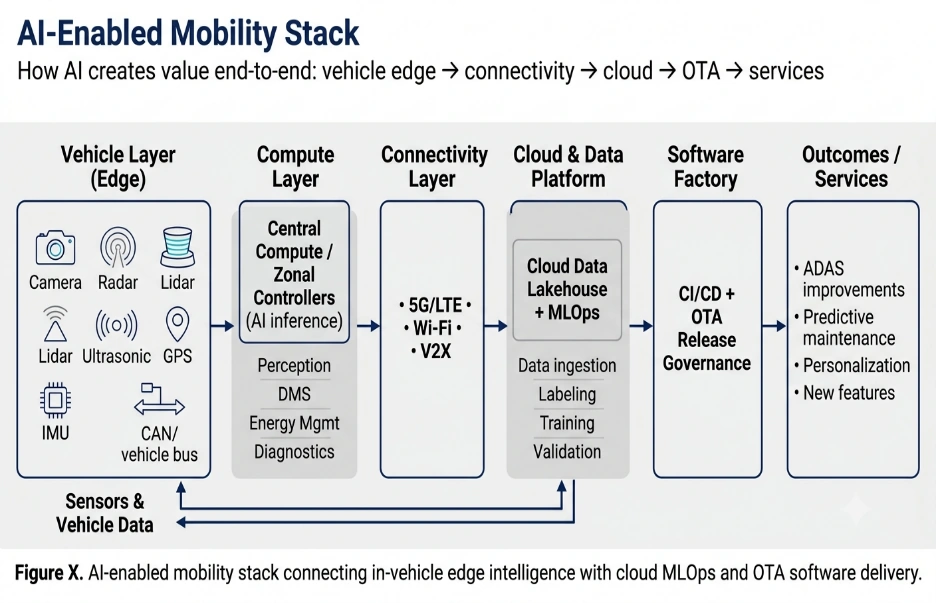
The mobility stack connects vehicle hardware to cloud operations and back to the vehicle:
 View full size
Figure 1. AI-enabled mobility stack connecting in-vehicle edge intelligence with cloud MLOps and OTA software delivery.
Vehicle edge: Cameras, radar, LiDAR, inertial measurement units, and vehicle networks provide data. On-board compute: Centralized systems run time-sensitive tasks such as perception, driver monitoring, and diagnostics. Connectivity: Telematics and, where available, 5G or vehicle-to-everything services transmit selected data. Cloud data platform: Data systems support curation, scenario analysis, labeling, and model development. Software factory: CI/CD pipelines build, test, and govern software and model releases. Deployment: Validated, signed updates are delivered through controlled OTA processes.
Because connectivity and cloud services cannot be assumed to be continuously available, essential vehicle functions must remain safe and reliable on board.
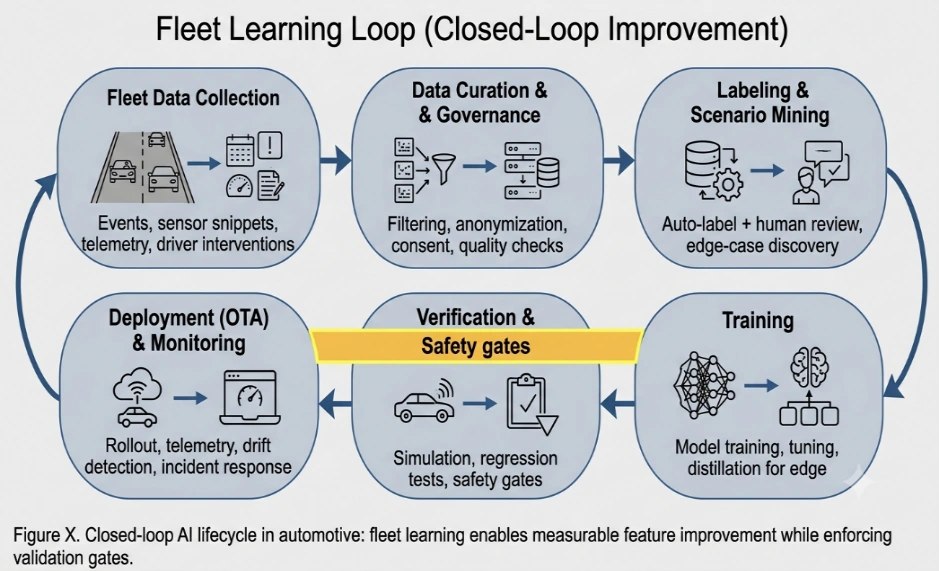
3. The Continuous Fleet Learning Loop
Static models are inadequate for autonomous driving and predictive management due to the complexity of real- world edge cases. Fleet Learning Loops solve this via automated closed-loop lifecycle management.
 View full size
Figure 2. Closed-loop AI lifecycle in automotive: fleet learning enables measurable feature improvement while enforcing validation gates.
Lifecycle Phases
Fleet Data Collection: Triggered upload of sensor snippets based on hard-braking events, manual driver interventions, or system disengagements. Data Curation & Governance: Ingestion pipelines filter noise, scrub personally identifiable information (PII / faces / license plates), and enforce consent policy checks. Labeling & Scenario Mining: AI-assisted auto-labeling systems isolate rare edge cases (e.g., unusual weather, non- standard road construction) for human review. Model Training: Retraining, hyperparameter optimization, and neural network distillation to fit target edge silicon constraints. Verification & Validation (Safety Gates): Automated regression testing, Hardware-in-the-Loop (HIL) simulation, and strict safety validation prior to deployment. Deployment & OTA Monitoring: Staggered canary rollouts, telemetric drift monitoring, and automated safety rollback strategies.
4. Vehicle AI Safety, Security & Governance
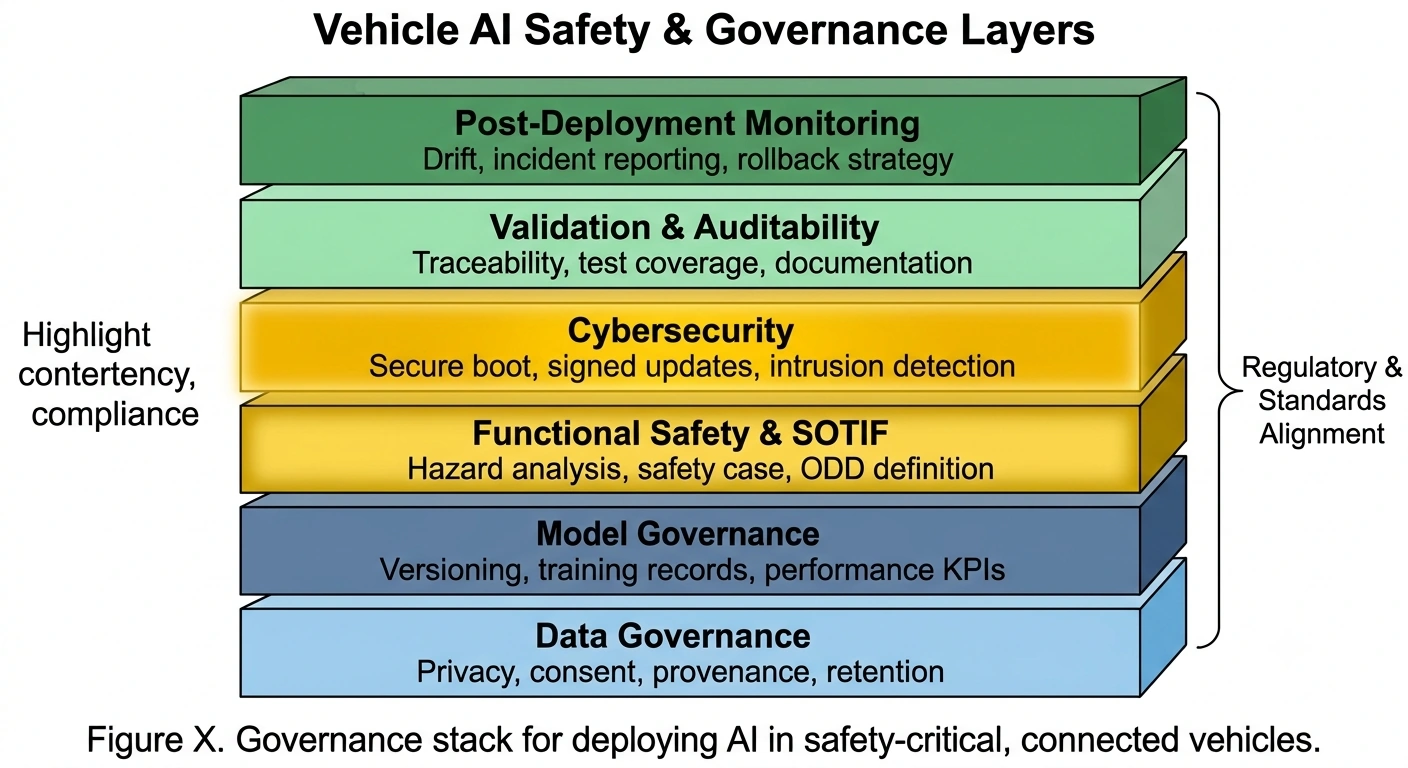
Due to the safety-critical nature of automotive hardware, deployment of AI models demands multi-layered governance across both hardware and software boundaries.
 View full size
Figure 3. Governance stack for deploying AI in safety-critical, connected vehicles, highlighting core compliance layers.
Layer Breakdown
Post-Deployment Monitoring: In-field tracking of model drift, dynamic performance degradation, real-time anomaly detection, and automated OTA rollbacks. Validation & Auditability: Traceability matrix linking every safety requirement to training datasets, simulation results, and software build artifacts. Cybersecurity Layer: Hardware root-of-trust, secure boot, cryptographic update signing, and in-vehicle Intrusion Detection Systems (IDS) complying with UN ECE R155/R156 standards.
Functional Safety & SOTIF (Safety of the Intended Functionality): ISO 26262 functional hazard analysis combined with ISO 21448 (SOTIF) evaluation to prevent unsafe system behavior caused by situational hazards or performance limitations. Model Governance: Rigorous tracking of model lineage, hyperparameter configurations, dataset versions, and edge execution KPIs. Data Governance: Managing compliance frameworks (GDPR, CCPA), user consent flags, anonymization pipelines, and data retention policies.
5. Value Chain Impact Mapping
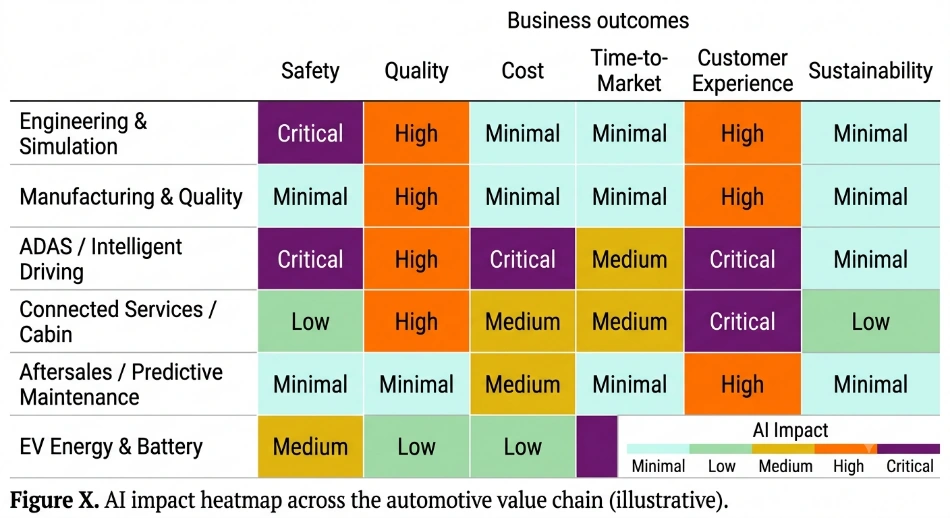
AI deployment yields varying returns across different automotive domains. The heatmap below summarizes where AI generates operational and financial value:
 View full size
Figure 4. Impact matrix mapping AI application domains against business outcomes.
High-Impact Domain Highlights
Engineering & Simulation: Generative design algorithms optimize structural components for mass reduction, while synthetic scenario generation compresses testing timelines for ADAS validation. Manufacturing & Quality: High-speed vision models perform automated inline inspection for body-in-white welding, paint finish uniformness, and assembly torque verification. ADAS & Autonomous Systems: Real-time perception and multi-modal trajectory prediction significantly reduce safety incidents. EV & Battery Management: Physics-informed neural networks (PINNs) monitor state-of-charge (SoC) and state- of-health (SoH) in real time to extend battery lifecycles and optimize active thermal conditioning.
6. Strategic Takeaways for Automakers
To successfully operationalize AI across the value chain, automotive enterprises must address three execution requirements:
Decouple Hardware and Software Lifecycles: Transition from ECU-centric sourcing to centralized compute architectures designed with headroom for future AI models. Standardized Data Infrastructure: Implement centralized data ingestion and MLOps platforms that connect in- field telematics with R&D simulation tools. Integrate Safety and Governance Early: Embed SOTIF, functional safety (ISO 26262), and cybersecurity compliance directly into CI/CD build pipelines rather than treating them as post-development verification steps.
References
1. ISO.ISO 26262: Road vehicles—Functional safety. https://www.iso.org/standard/68383.html
2. ISO.ISO 21448: Road vehicles—Safety of the intended functionality (SOTIF). https://www.iso.org/standard/77490.html
3. United Nations Economic Commission for Europe (UNECE).UN Regulation No. 155: Cyber security and cyber security management system. https://unece.org/transport/documents/2021/03/standards/un-regulation-no-155-cyber-security-and-cyber
4. UNECE.UN Regulation No. 156: Software update and software update management system. https://unece.org/transport/documents/2021/03/standards/un-regulation-no-156-software-update-and-software
5. European Union.Regulation (EU) 2016/679 (General Data Protection Regulation). https://eur-lex.europa.eu/eli/reg/2016/679/oj
6. California Legislative Information.California Consumer Privacy Act of 2018, as amended. https://leginfo.legislature.ca.gov/faces/codes_displayText.xhtml?division=3.&chapter=20.&part=4.&lawCode=CIV
7. SAE International.Taxonomy and Definitions for Terms Related to Driving Automation Systems for On-Road Motor Vehicles (SAE J3016). https://www.sae.org/standards/content/j3016_202104/
8. National Institute of Standards and Technology (NIST).Artificial Intelligence Risk Management Framework (AI RMF 1.0). 2023. https://doi.org/10.6028/NIST.AI.100-1
9. World Economic Forum.The Future of the Automotive Value Chain: 2025 and Beyond. 2020. https://www.weforum.org/publications/the-future-of-the-automotive-value-chain-2025-and-beyond/
10. McKinsey & Company.The case for an end-to-end automotive software platform. https://www.mckinsey.com/industries/automotive-and-assembly/our-insights
Why and how to volunteer
A full part of the professional journey, with responsibilities that matter.
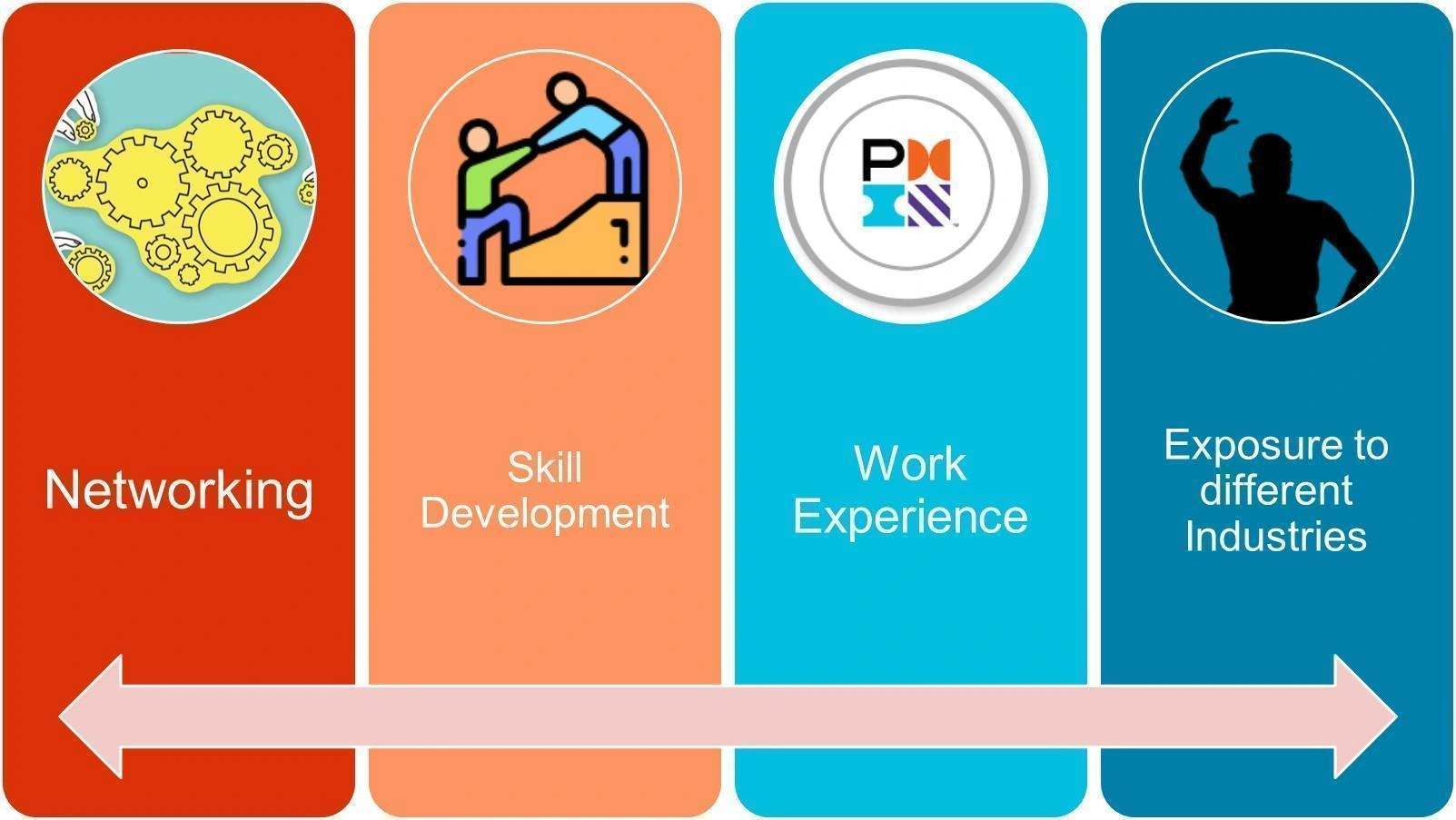
Volunteering puts professional experience to work for a community while giving you a setting in which to learn by doing. PMI’s global guidance highlights four connected benefits: widening professional reach, contributing to the profession, developing skills and building lasting relationships. The useful starting point is a contribution you can make reliably.
What you can contribute locally
 View full size
The Chapter’s network includes more than 150 volunteers. Their work spans events, learning content, membership, publications, academic engagement, corporate outreach, technology, mentoring and social purpose. A role may involve organizing a session, improving a digital service, editing an article or supporting a programme. It should have an understood purpose, scope and time commitment.
How to get started
Use the Chapter volunteer route or contact Volunteer Management with your interests, relevant skills and realistic availability. PMI’s Volunteer Engagement Platform (VEP) is its official recruitment route for published opportunities. Review the role description, expected contribution, location or mode, duration and application conditions before applying.
The Chapter’s structured process includes a discussion of fit, portfolio interaction and formal onboarding. Begin with the role you can deliver well. Volunteer leadership develops through contribution and collaboration; participation does not automatically lead to an appointment or elected position.
Learning and recognition
PMI offers volunteer-development resources through its Leadership Institute. Locally, programme responsibility provides opportunities to practice communication, planning, stakeholder coordination and follow-through. Reflecting on those experiences can make them useful beyond the immediate assignment.
 View full size
Eligible volunteering may support Giving Back to the Profession PDUs under PMI’s current rules. Check the requirements for your credential and
retain a record of the activity and time spent. PDU eligibility should follow the nature of the work rather than being assumed for every volunteer task.
Beyond local Chapter roles, PMI lists individual-contributor and team opportunities, including contributions to professional knowledge and social impact. Explore the opportunity that fits your skills and circumstances rather than taking on more than you can sustain.
Apply or express volunteer interest
Contact Volunteer Management | volunteer@pmipunechapter.org
MEMBER AND COMMUNITY FACILITIES
Collaboration space for focused work
A Chapter facility for meetings, learning and professional collaboration.
 View full size
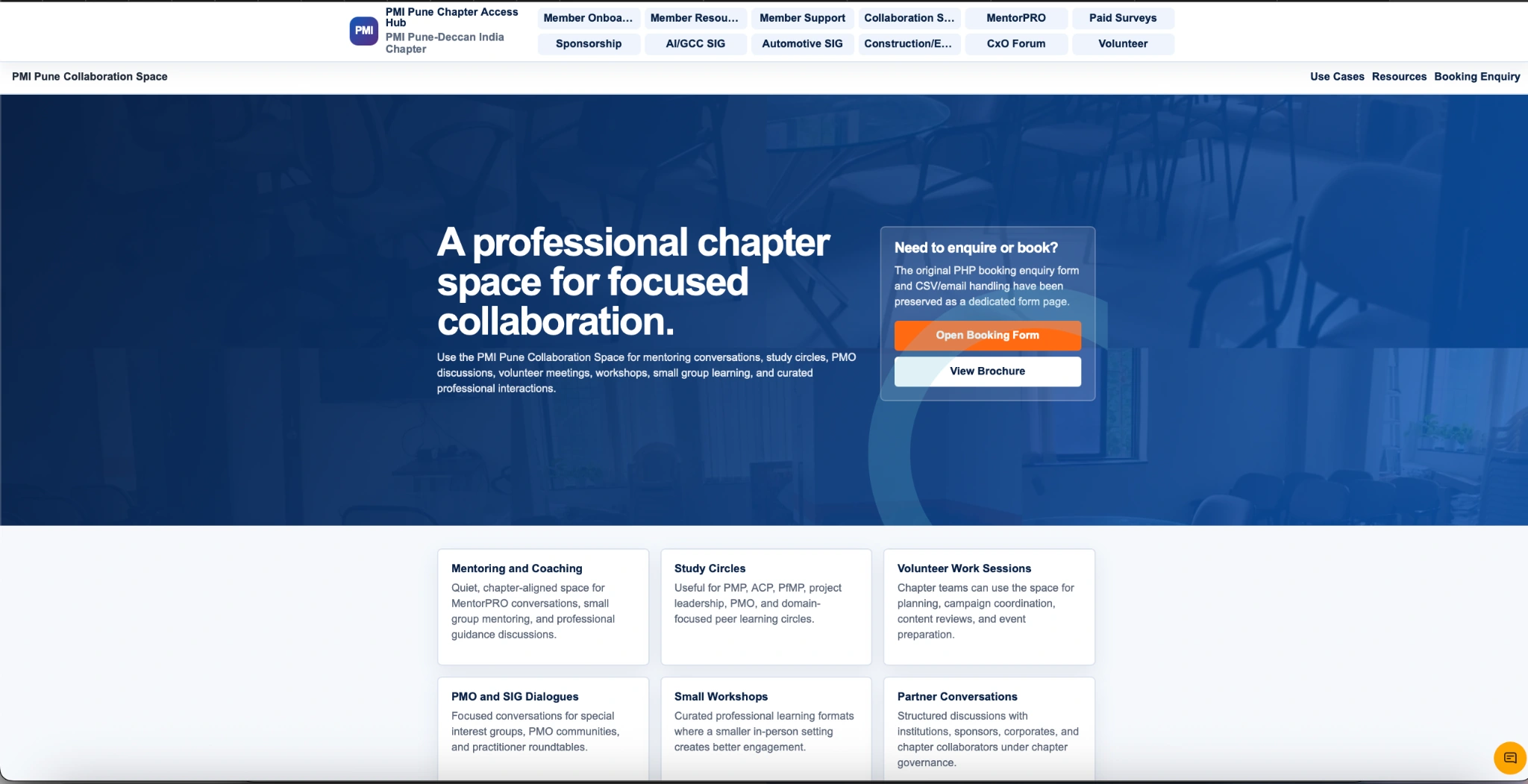
The collaboration-space service page supplied in the revised newsletter.
The Chapter has introduced its Co-Working and Meeting Space Initiative for members, corporate partners, academic institutions and the wider professional community. The initiative offers access at a minimal charge for members and non-members. Exact charges, availability and booking conditions should be confirmed for the intended use.
How the space can support participation
A suitable meeting setting can help a small teamwork through an agenda, prepare a learning activity or hold a focused professional discussion. The value of the facility depends on a clear purpose and an agreed booking. Members should use the published service information to understand whether the room and facilities fit their needs.
Enquire with enough detail
When enquiring, provide the proposed date, time, group size, purpose and any equipment or connectivity needs. Confirm the room capacity, facilities, charges, access arrangements and cancellation conditions before making commitments to other participants. Do not assume equipment or services that have not been confirmed by the Chapter office.
Proceeds support Chapter development programs, student outreach and professional-community events. This connects the service with the Chapter’s wider work while giving members another practical way to use the professional community.
PAID MEMBER FAMILY
Welcome to our new members
A month-by-month record of the people joining the Chapter community.
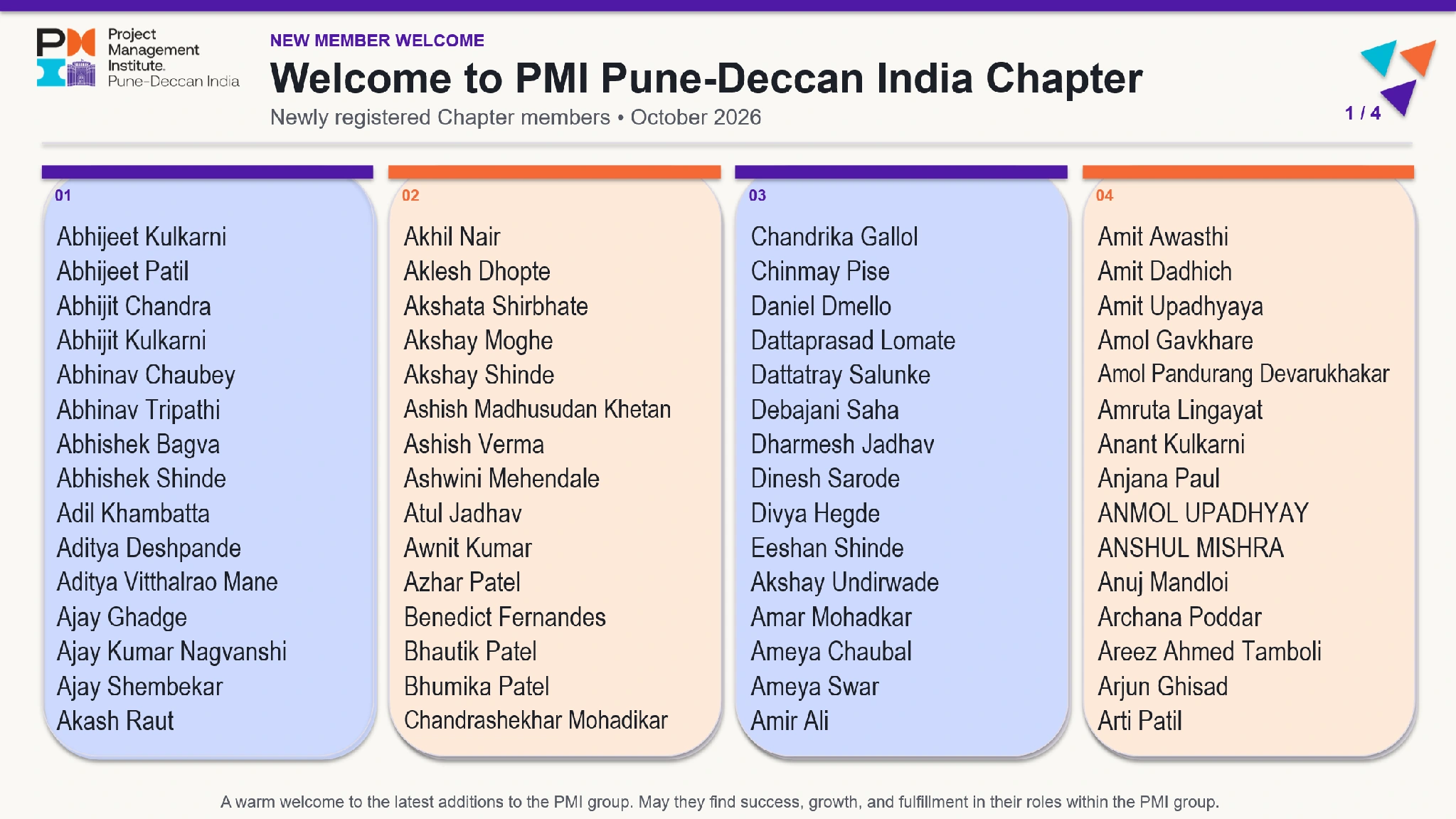
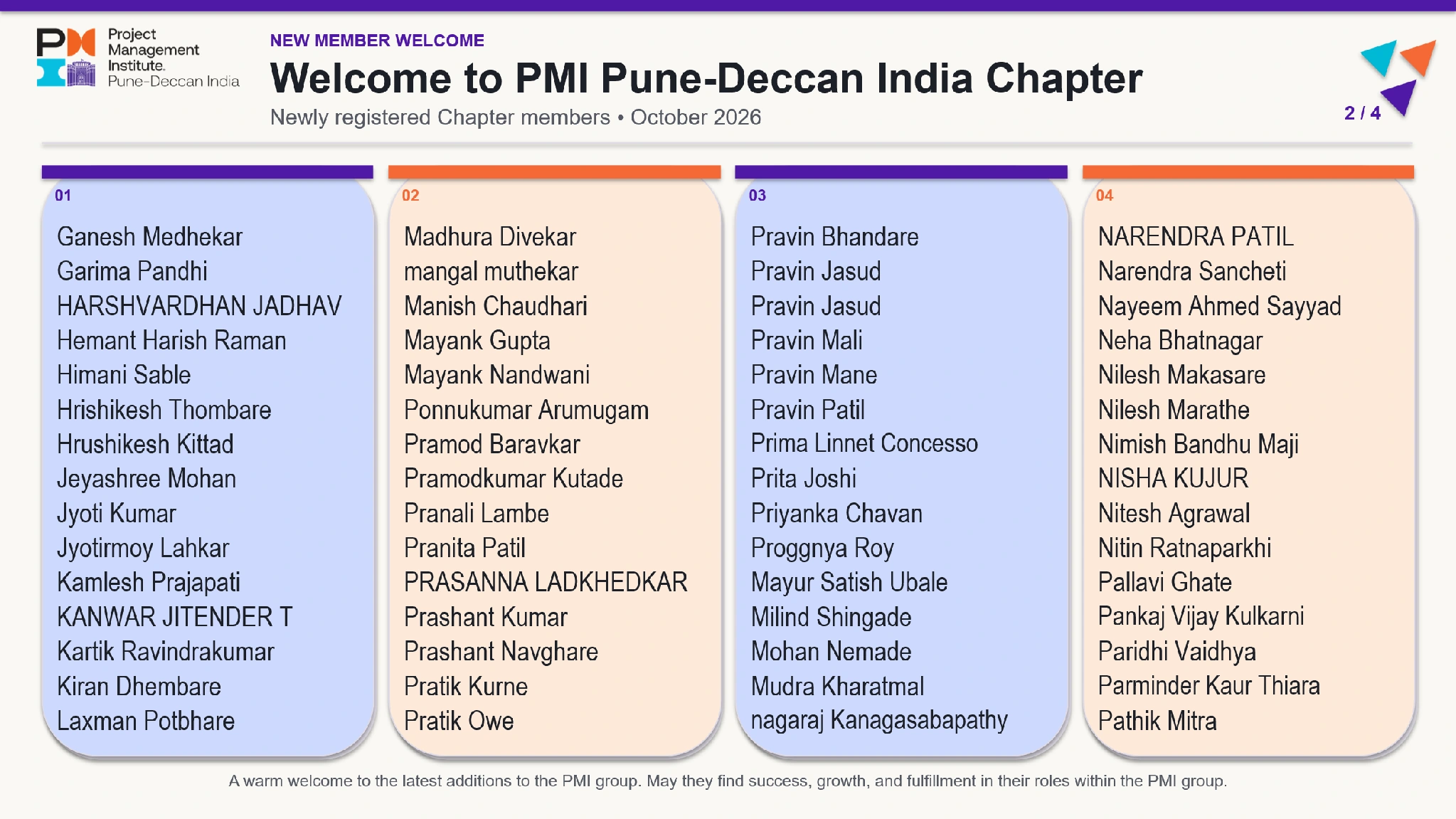
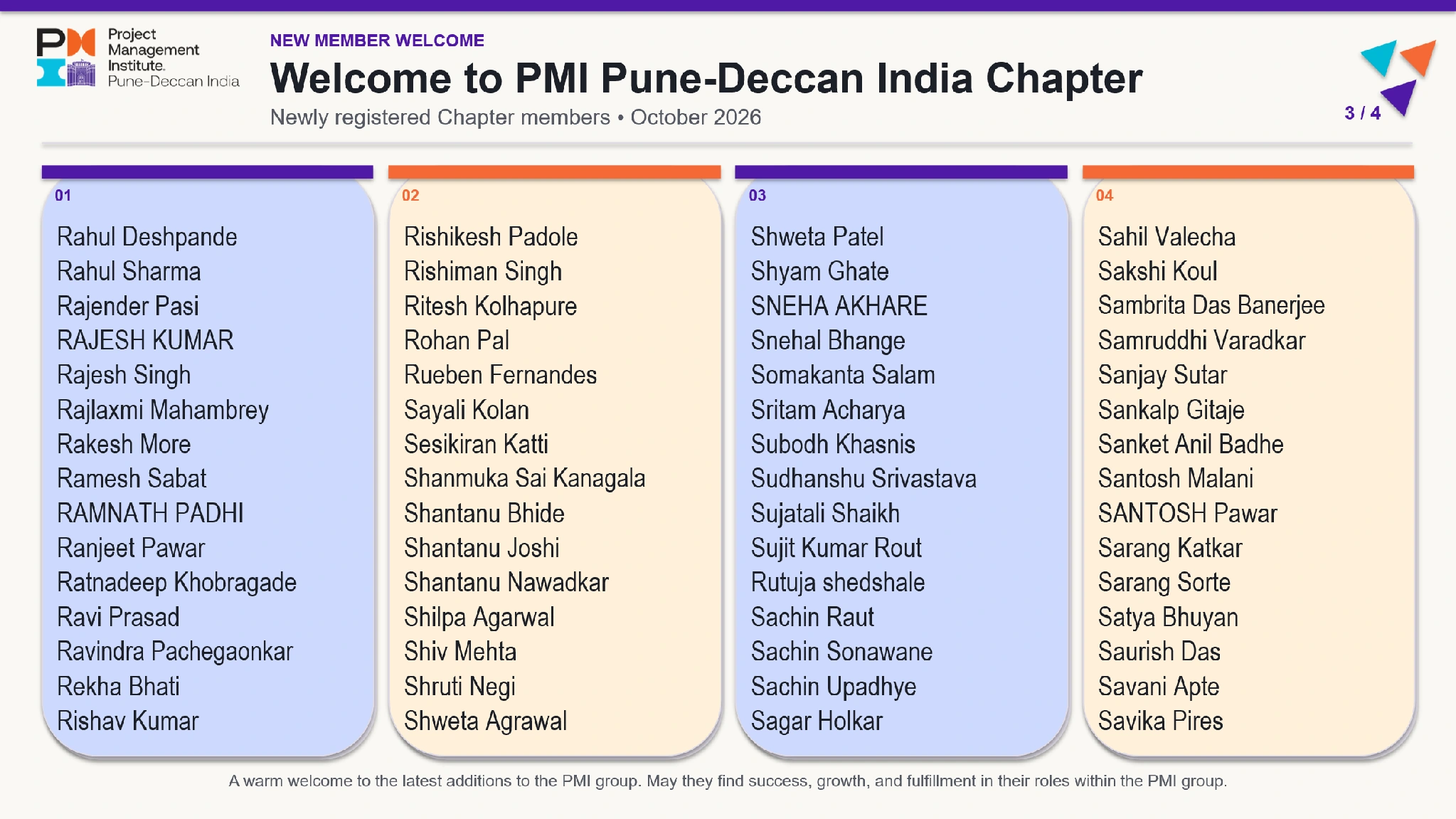
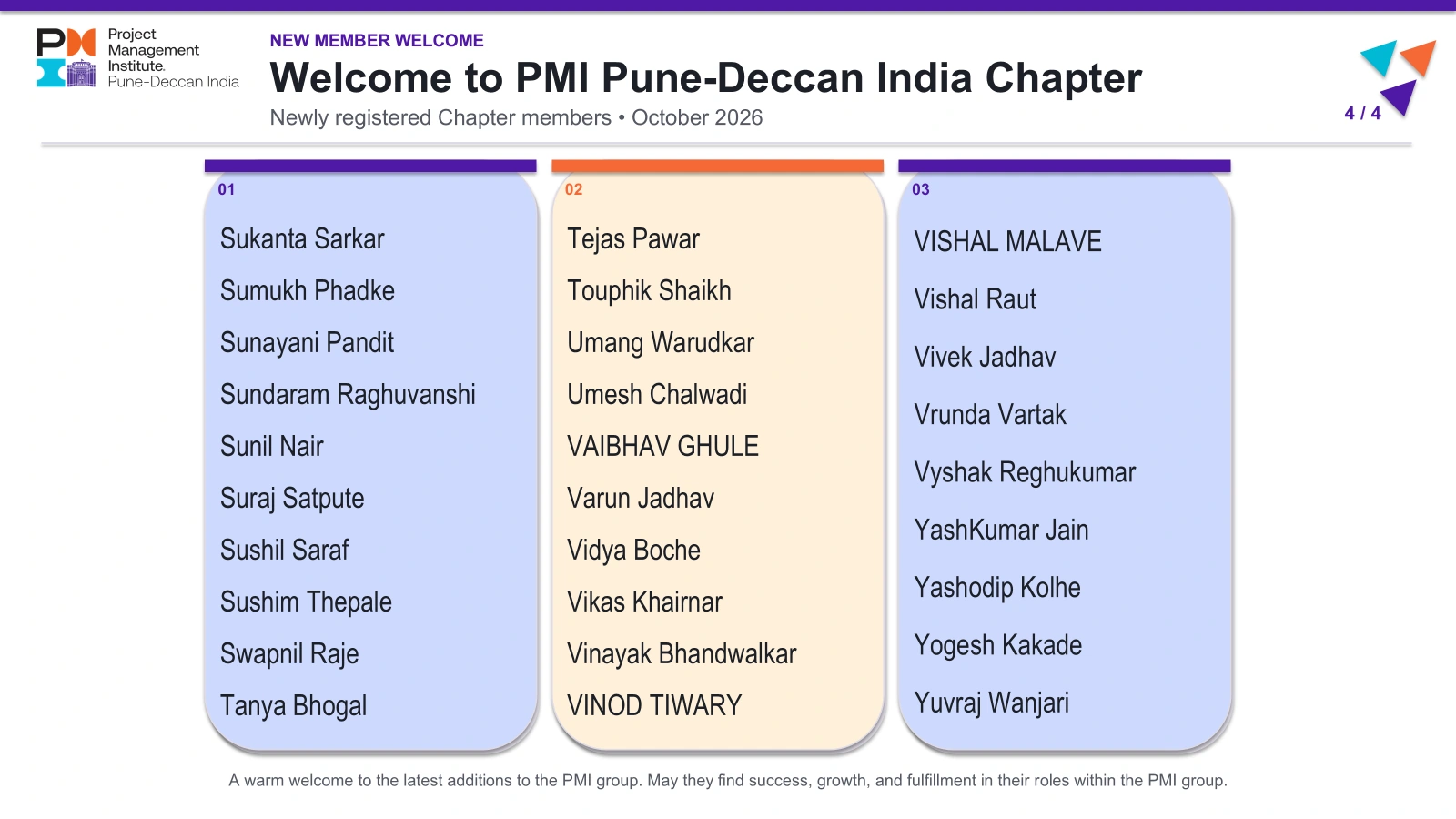
We welcome the members who joined the paid Chapter family during the reporting period. Monthly seminars provide an opportunity to introduce and felicitate members on stage. This section gives our new members a permanent place in Member’s Dialog and helps fellow members recognize new faces.
The monthly register celebrates members by joining month and records the seminar at which they were welcomed. When a welcome takes place in a later month, both dates can be recorded so the account remains clear.
 View full size
 View full size
Your first month with the Chapter
Begin with Member Onboarding in the Hub, identify a learning session and explore the specialist community relevant to your interests. If you are unsure where to begin, use Member Support. Introducing yourself at a seminar can help you find peers, while a small contribution can be a way to build a more sustained connection.
CELEBRATING PROFESSIONAL MILESTONES
Congratulations to our certification achievers
Recognizing the effort behind a new professional credential.
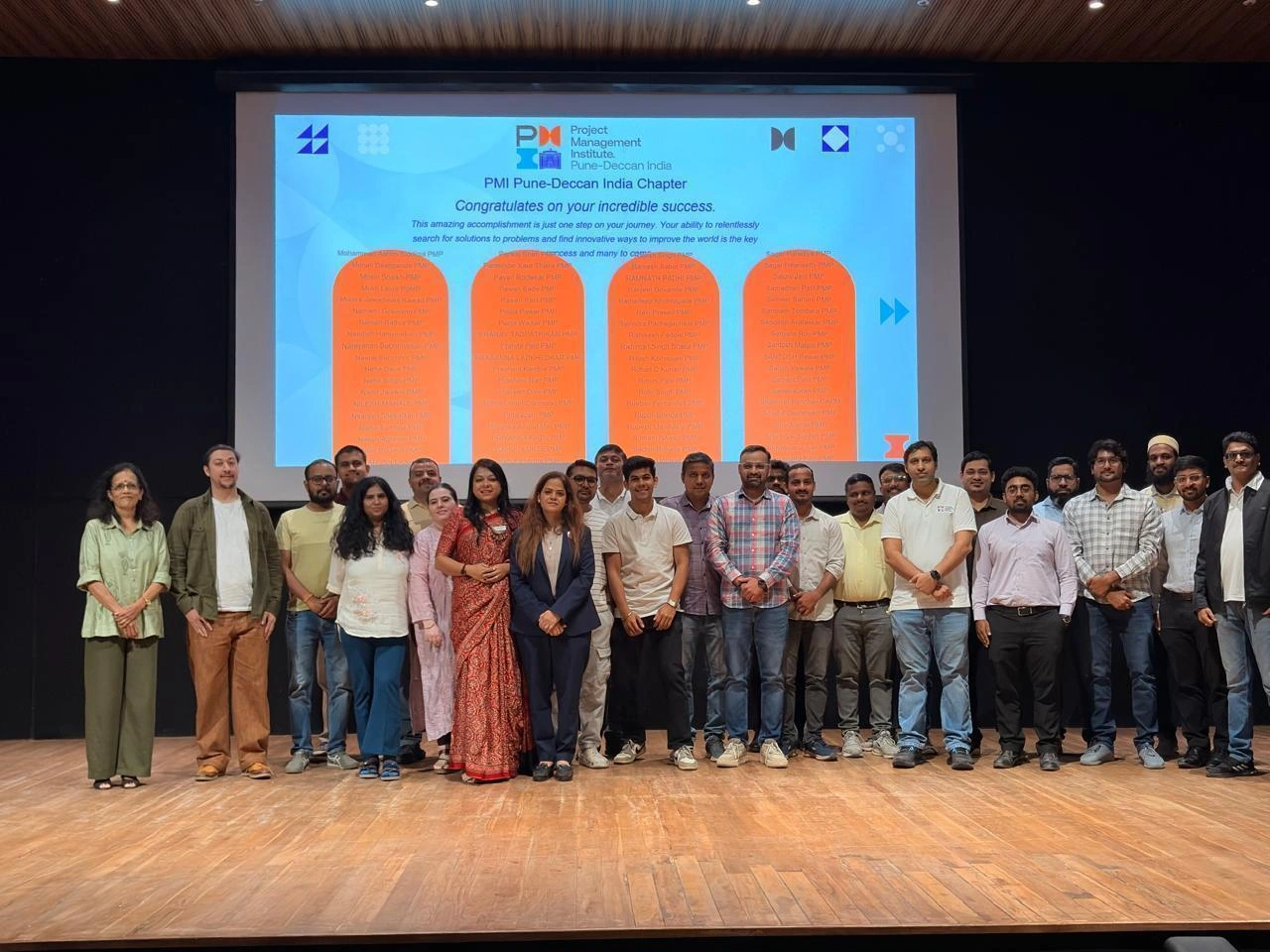
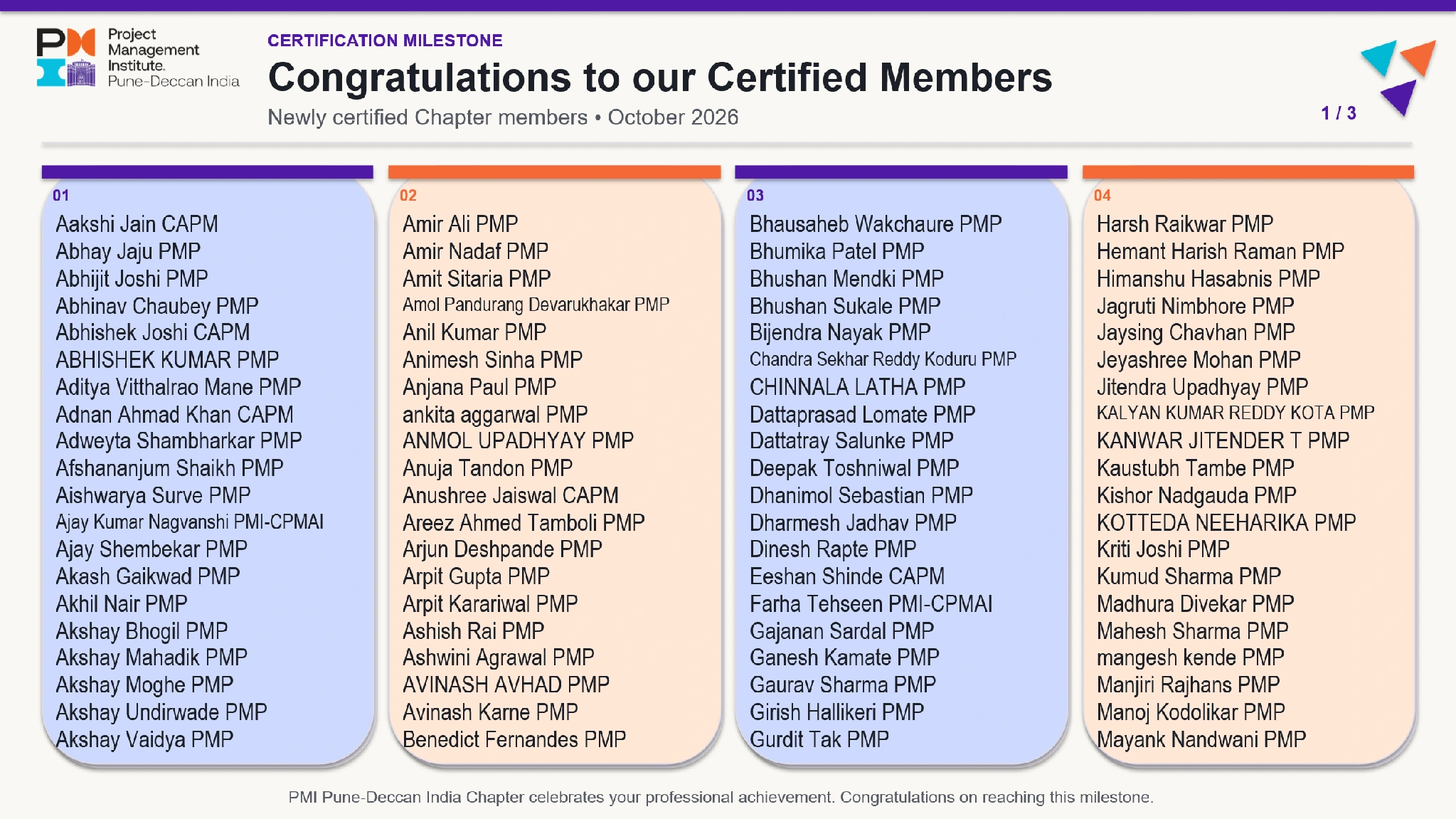
A certification reflects a member’s commitment to professional development. We congratulate the members whose achievements were recognized during the reporting period and celebrate the learning and preparation behind those milestones. The Chapter’s monthly seminars provide a setting for their felicitation on stage.
 View full size
Members recognized for professional certification achievements during the October Monthly Seminar
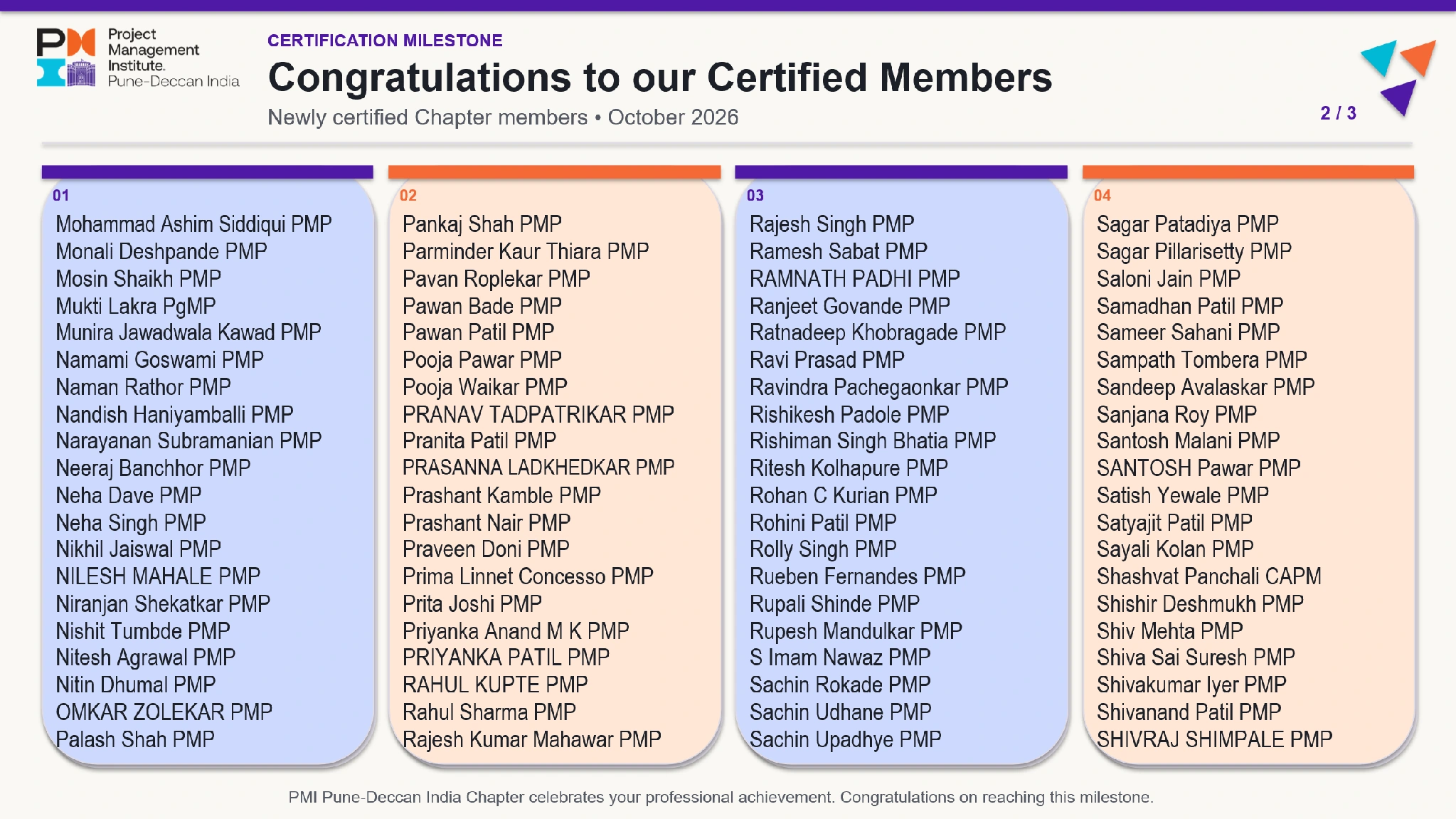
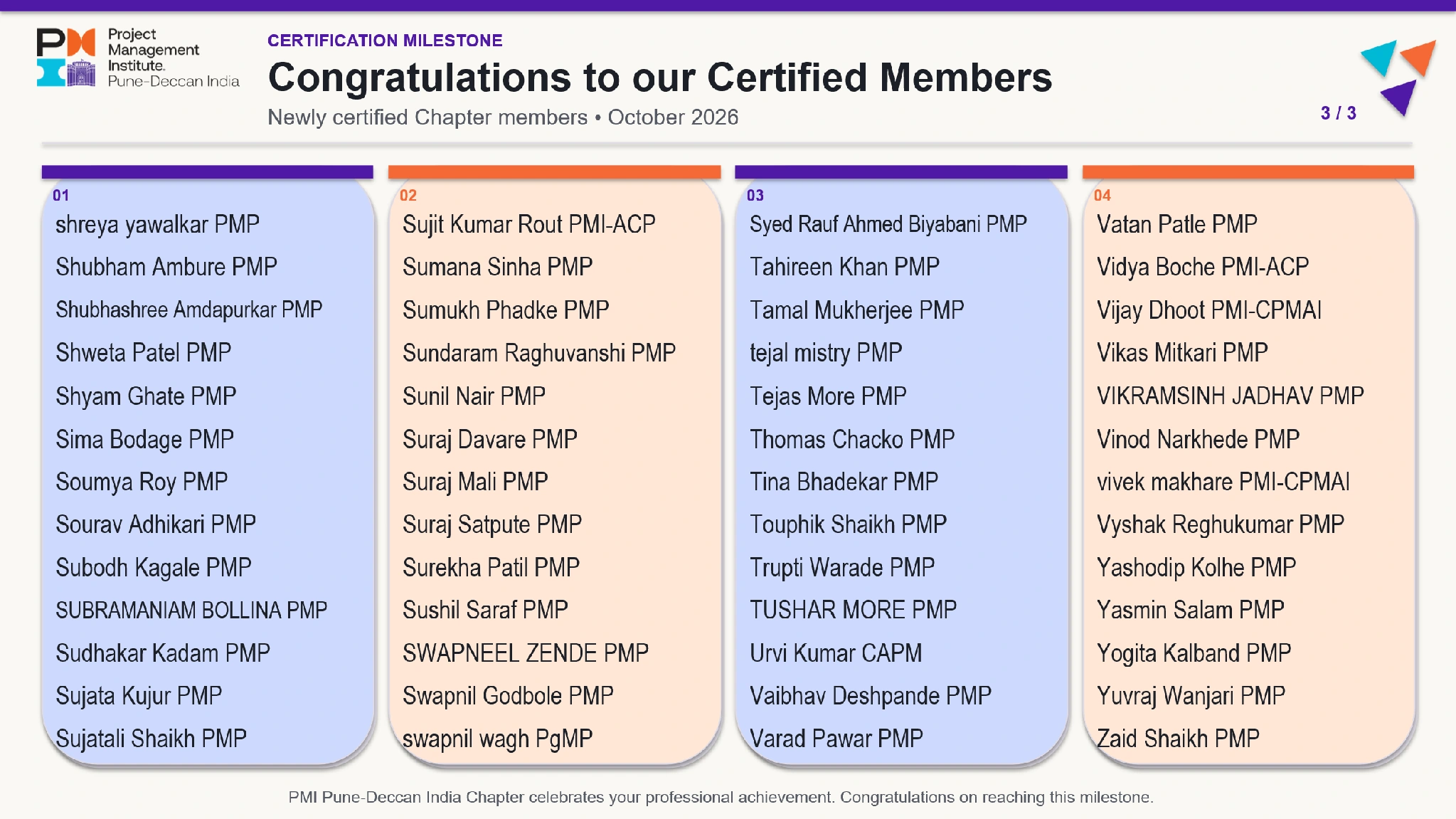 View full size
Members wishing to be included can provide their preferred published name, credential, achievement month and a short learning reflection to the Publications team. Please do not send unneeded identity documents or full certificate identifiers for publication.
Share your certification milestone| publications@pmipunechapter.com
MEMBER BENEFIT AND PARTNER PROMOTION
Partner offer for the Chapter community
A supplied advertiser promotion, separate from Chapter programme reporting.
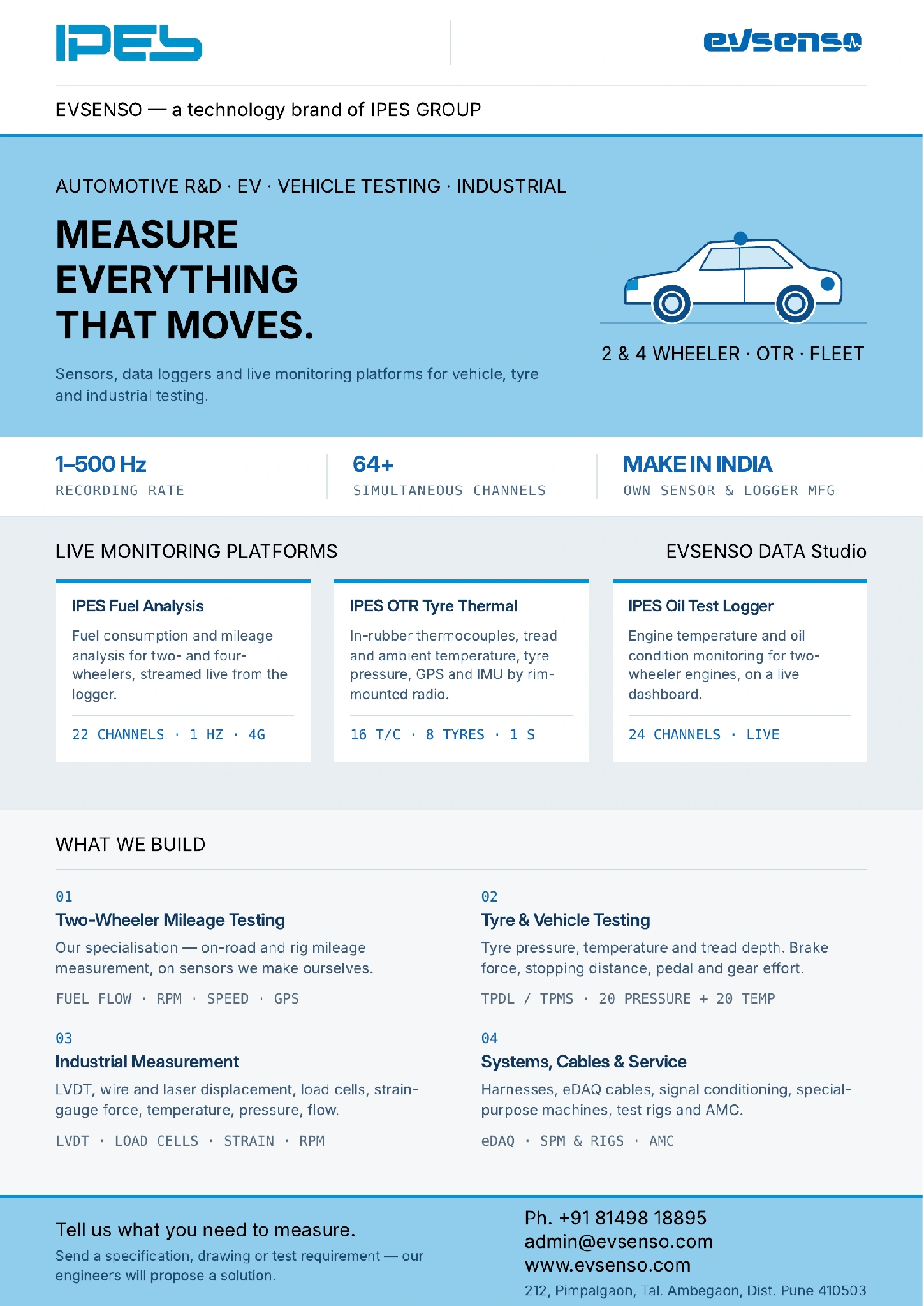 View full size
SOURCES AND ISSUE COMPLETION
Sources behind this edition
Primary Chapter material and official PMI guidance used for the introductory pages.
Programme reporting is based on the source material supplied for the October 2026 edition of Member’s Dialog. The supplied formal Chapter deck provides context for the Chapter offering, SIG focus areas, academic engagement, PWL and volunteering. These introductory descriptions are kept distinct from dated delivery claims.
Official references
EDITORIAL TEAM AND SUBMISSIONS
Write for Member’s Dialog.
Editorial team
| Responsibility | Name or team |
|---|---|
| Chief Editor | Rinoo Rajesh, President & CEO |
| Managing Editor | Lovely Roy, GM - Publications |
| Portfolio and section editors | Vallabh Kshirsagar |
| Copy editing and fact checking | Afreen Bano |
| Design and production | Vallabh Kshirsagar |
| Photographs and contributor coordination | Afreen Bano |
How to submit an article or contribution
Send your contribution to publications@pmipunechapter.com. Put “Member’s Dialog submission” and a short topic in the subject line. We welcome practitioner lessons, member experiences, project case reflections, interviews, event takeaways, book or resource reviews and questions that deserve a wider professional discussion.
For an article, a suggested starting length is 500–800 words. Shorter field notes and event reflections are welcome. Explain the situation, the decision or challenge, and what another member could learn. Include a proposed title, your preferred published name, a short professional introduction and contact details for editorial follow-up.
Send editable text and any photographs as separate files. Include captions, names, event dates and credits, and confirm permission to publish. Cite the sources for external claims. Remove confidential client or employer information and disclose relevant commercial interests so the team can assess the contribution fairly.
Certification achievers and new members can submit their preferred name and verified milestone month for the recognition sections. Programme teams should provide the activity date, delivery summary, member takeaway, next participation route and approved photographs.
NEXT ISSUE — Submission deadline 20th Nov 2026
Managing Editor contact – Lovely Roy,gen-mgr-po-pub@pmipunechapter.com
The editorial team may work with contributors on clarity, length and placement. Submission does not guarantee publication. Member’s Dialog grows more useful when the community shares experience with care and makes it understandable to others.
The conversation continues.
Your Chapter becomes more valuable when you use it.
 View full size
ONE ISSUE. THREE NEXT STEPS.
Member’s Dialog is a record of the Chapter — and an invitation to shape what comes next.
Explore. Participate. Share what you learn.
MEMBER ACCESS HUB Open the Chapter hub
WRITE TO US publications@pmipunechapter.com
NEXT ISSUE Submission deadline: 20November 2026